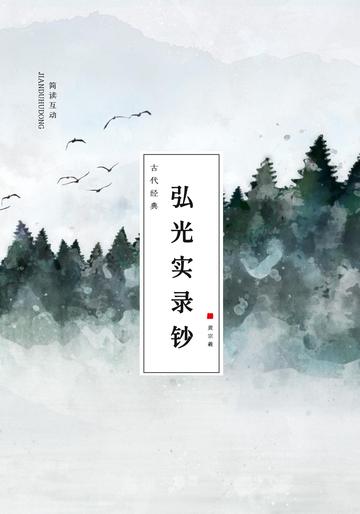
The Hongguang Veritable Records, Transcribed is generally believed to have been written by Huang Zongxi, a thinker of the late Ming and early Qing dynasties. This historical work recounts major political changes and significant events during the Southern Ming Hongguang reign, the Prince of Fu's regime established in 1644. The book consists of four volumes and is written in a style close to official records or daily court diaries, focusing primarily on events while also including historical commentary and accounts of notable figures. It begins with the Prince of Fu's enthronement in Nanjing in the seventeenth year of the Chongzhen reign and continues through the regime's downfall. It covers historical materials such as internal power struggles, military campaigns, officials' memorials, and imperial edicts. Its narrative emphasizes eyewitness accounts and official reports from the time, making it a valuable reference for studying the early years of the Southern Ming.
The book records the complex political situation within the Hongguang regime, including the rule of key ministers such as Ma Shiying and Ruan Dacheng at the Prince of Fu's court, Shi Kefa's campaign to resist the Qing as commander-in-chief, the military activities of the Four Garrisons north of the Yangtze, and social and political controversies surrounding the so-called false crown prince. Drawing on court gazettes, memorials, and personal observations, the author combines detailed historical records with commentary and opinions. The work is thus both valuable as a historical source and a reflection of the author's deep concern for his era.
Although scholars have debated the authorship of The Hongguang Veritable Records, Transcribed, Huang Zongxi is generally considered to have had a close connection with it. The book offers important clues for researching Southern Ming history and understanding the political conflicts of the Ming-Qing transition. Reading it reveals both the struggle for power in a time of war and a historian's reflections on learning from the past, making it especially appealing to readers interested in China's history at a time of profound change.