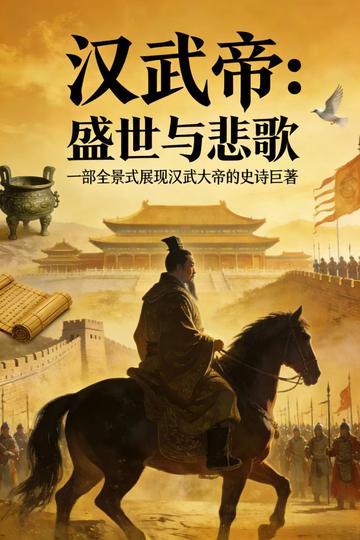
"Emperor Wu of the Han Dynasty: Prosperity and Elegy" is a long historical novel centered on the fifty-four-year reign of Emperor Wu of the Han Dynasty Liu Che. It is divided into four volumes. The work goes beyond the one-way praise of the hero's achievements, and takes the theme of "the glorious sky and the towering sky" as its keynote, and goes deep into the complex inner workings of the empire at its peak. We not only write about the heroic development of "emptying out the Western Regions" and "killing people even if they are far away", but also gaze at the difficulties of people's livelihood under the iron heel, the ideological unity behind the dominance of Confucianism, and the common destiny of emperors, generals and common people in the glory of the prosperous age.
The novel uses a panoramic perspective of the heights of temples and the distance of rivers and lakes, and weaves a profound picture of power, ideals, costs and reflections through the intertwining fates of historical figures such as Emperor Wu of the Han Dynasty, Wei Qing, Huo Qubing, Sima Qian, Sang Hongyang, and fictional characters such as Lu Jing, a scholar from a poor family, and Seleucus, a businessman from the Western Regions. The story starts from the young emperor's first training of power, to the arduous trial of the empire's edge, through the peak and prosperity, and finally leads to the reflection of the old age of prosperity and decline, asking whether the name "Weiyang" is a wish for glory and longevity, or a prophecy of prosperity and decline. This is an epic with historical thickness, literary warmth and human touch. It aims to explore how a nation balances ambition and governance on the road to prosperity, and how individual light shines or is annihilated in the torrent.