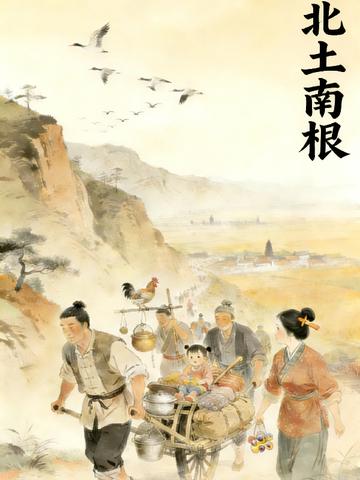
In the autumn of the 21st year of Hongwu in the Ming Dynasty, Hujiazhuang, Zaoqiang County, Zhending Prefecture, Hebei Province. The county government officials beat gongs and announced along the village: "According to the emperor's decree, the people must be relocated to Lu! For every household with a population of five or more, one of the three will be selected; if there are more than ten households, one of the two will be selected. Within ten days, go to the county government to register!"
There are thirteen members in the Hu family, and according to the law, there are six children. The old man of the Hu family discussed with his three sons all night, and finally decided: the eldest son Hu Yanqing, his wife and two sons, and the second son Hu Yanfu's family of three, a total of six people, should move; the old man and his third son Hu Yanshou would stay at the ancestral home.
On the day of departure, Mr. Hu took out a handful of loess from the ancestral temple, put it into a green cloth bag, and handed it to his eldest son: "Yanqing, if you arrive in Shandong, if the soil and water are not suitable for you, take the soil and water to drink. Remember, my Hu family has been farming and reading for generations. Even if it is a barren land, we must pass on the sound of books." In the dim light of dawn, the immigrants were escorted by officers and soldiers and embarked on the road south. Along the way, they encountered plague, banditry, and famine. When they arrived at Jinan Prefecture, the government resettled the immigrants in a barren land seventy miles north of the city, named "Hujiawa". This place was originally the old course of the Yellow River, with sand and alkali everywhere and reeds growing thickly.
Hu Yanqing looked at the vast wilderness, took out the earth bag given by his father, threw it into the newly dug well, and said to the tribe: "From now on, this is our home."