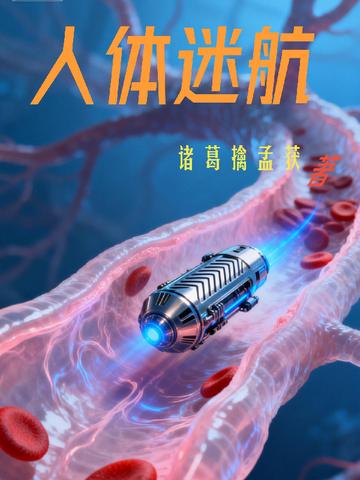
Genius scientist Song Yin volunteered to become the first "living microscopic explorer" in order to treat Professor Gu who was suffering from a strange disease. He and his mentor Professor Chen Mo sneaked into the patient's body and trekked through the cellular universe, but they were surprised to find that all the lesions pointed to a larger mystery: after the body lost its original consciousness, the depths of its biological matrix were like the echo of an empty mountain, slowly gestating some kind of ignorant and new "self".
As the exploration deepens, an ethical storm sweeping the world has arisen: If the body can give birth to new consciousness on its own, does "downloading" the old consciousness back to the body constitute murder? Is immortality an elegant evolution or a clumsy usurpation of life itself?
The novel is based on hard-core science fiction and integrates cutting-edge fields such as medicine, quantum biology, and neuroscience to build a grand and delicate "microcosm of the human body." From the torrent of blood vessels to the neural jungle, from intestinal flora to the blood-brain barrier, every adventure is an inquiry into the essence of life. The seeds of consciousness buried by Professor Gu Tingyuan, Su Yu's twenty years of waiting in the deep sea, Dr. Li's father's love wandering between resurrection and letting go, the fourteen years when the clone Li Nian never awakened but was always loved - the lost ways and choices of countless individuals are intertwined into a collective metaphor for mankind when facing the proposition of immortality.
This is not a technical fantasy about "how not to die", but an existential question about "why to live". When the journey of consciousness reaches the end, the answer has already been written in every moment of choosing to let go, every ray of yearning that passes through the nutrient solution, and the unsigned question that travels across the entire Pacific:
"I wish mankind to find its way back."
Reader comments
The ideas are avant-garde and the plot is reasonable!
"Body Trek" uses brain machines and nanotechnology as the basis to create a shocking microscopic adventure of the human body. From blood vessel tunnels to nerve jungles, the author uses delicate brushstrokes to transform cold medical knowledge into a magnificent microscopic universe. The rush of red blood cells and the resonance of neurons all have a sense of picture. The story takes Song Yin's adventure as the main line, connecting the deep propositions of the gestation of consciousness and the ethics of science and technology. The sacrifice of the new consciousness and Professor Gu's perseverance make the cold technological narrative wrapped in the warmth of human nature. The ambition of Apophis and the betrayal of the inner ghost make the plot reverse layer by layer. In the adventure and game, it questions the nature of immortality and the meaning of life. It is a masterpiece that combines science fiction imagination and humanistic thinking.
The ideas are avant-garde and the plot is reasonable! "Body Trek" uses brain machines and nanotechnology as the basis to create a shocking microscopic adventure of the human body. From blood vessel tunnels to nerve jungles, the author uses delicate brushstrokes to transform cold medical knowledge into a magnificent microscopic universe. The rush of red blood cells and the resonance of neurons all have a sense of picture. The story takes Song Yin's adventure as the main line, connecting the deep propositions of the gestation of consciousness and the ethics of science and technology. The sacrifice of the new consciousness and Professor Gu's perseverance make the cold technological narrative wrapped in the warmth of human nature. The ambition of Apophis and the betrayal of the inner ghost make the plot reverse layer by layer. In the adventure and game, it questions the nature of immortality and the meaning of life. It is a masterpiece that combines science fiction imagination and humanistic thinking.