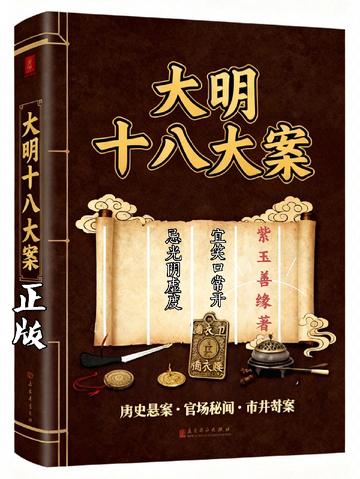
During the Wanli reign, the corpse of an official with his eyes gouged out appeared in a bustling street in the capital. Clutched in his arms was half a page of a torn manuscript bearing the words “Eighteen Great Crimes.” Jin Yi Wei captain Shen Yan was ordered to investigate, only to discover that the bloody case echoed an old treason trial from twenty years earlier, one that had implicated several clans. The number “eighteen” in the manuscript pointed to eighteen deliberately buried cases from the founding of the Great Ming: a drowned prince, missing tax silver, ghostly singing in the imperial prison at midnight...
Each case concealed a secret with the power to topple the dynasty.
As the investigation deepened, people around Shen Yan began dying one after another, and every clue led to the depths of the Forbidden City. When he found a mysterious map showing the positions of eighteen skeletons, hidden between the pages of a long-sealed copy of the Yongle Encyclopedia in the History Bureau, he realized he had long since become a discarded pawn in the game...
Highlights:
① Historical mystery meets classic detective fiction: Real Ming Dynasty cases form the basis for a series of locked-room puzzles full of twists.
② A dark tale of the dynasty: Each case corresponds to a real historical event from the Ming Dynasty, such as the Blank Paper Case and the Red Pills Case.
③ Eerie symbols and imagery: Historical elements such as eighteen interlocking mechanisms, the Hongwu secret files, and the yin-yang registers run throughout the book.
“These eighteen cases were a mirror left by the Hongwu Emperor to reveal the true faces of those who came after him.”
From the moment you turn to the first page, you are part of the game.