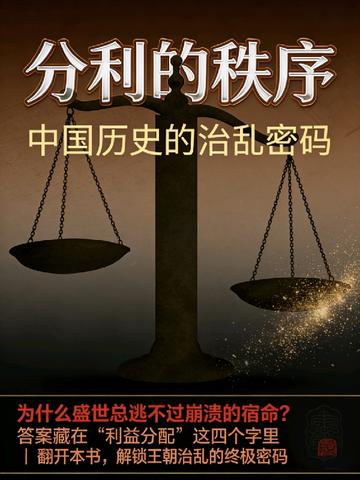
Where is the answer to the dynasty's cycle of chaos and chaos over the past three thousand years?
"The Order of Profit Distribution: The Code of Chaos in Chinese History" breaks out of the moral judgment framework of traditional historiography, takes profit distribution as the core key, and deconstructs the logic of the rise and fall of dynasties from the Tang to the Ming and Qing dynasties. This book builds a rigorous closed loop of "theoretical construction-subject analysis-law summary". It first uses the "power-resource-wealth" triangular model and analytical tools such as distribution scale and interest channel to lay the underlying framework for interpreting history; then it analyzes imperial power, civil servant groups, military groups, and The chess game between wealthy landowners, merchants and vagabonds and other diverse stakeholders clearly presents secret battles over distribution in key areas such as land taxation, salt, iron and water transportation, and imperial examinations and military achievements. It finally focuses on the inevitable dilemma of institutional rigidity and financial bankruptcy, revealing how imbalanced distribution became the ultimate driver of the collapse of a dynasty.
The book not only contains an in-depth review of the evolution of systems such as "registering households to equalize the people" and "one whip law", but also provides a subtle interpretation of the decision-making dilemmas of historical figures such as Hai Rui and Zhang Juzheng. It also puts historical reflections on the current interest pattern. It breaks the fog of grand narratives, takes readers through the appearance of dynastic changes, and gets a glimpse of the code of chaos hidden behind power, wealth and humanity.