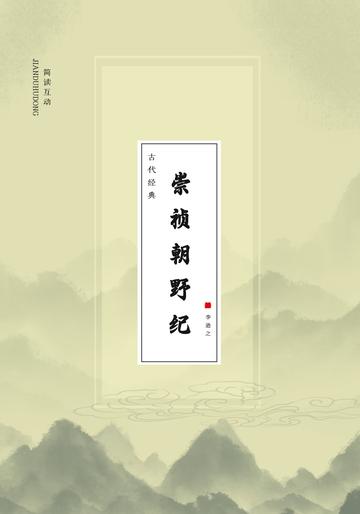
Chongzhen Court and Countryside Records is a historical chronicle compiled and edited by Li Xunzhi, a Qing dynasty historian. It was organized as a standalone work from the section on the Chongzhen reign in his extensive historical source text, Three Reigns: Court and Countryside Records. Li Xunzhi, courtesy name Fugong, was from Jiangyin in Changzhou Prefecture, South Zhili. A historian of the late Ming and early Qing, he was the son of Li Yingsheng, a member of the Donglin faction who was murdered by Wei Zhongxian's followers and posthumously vindicated in the first year of the Chongzhen reign. Li Xunzhi later considered himself a loyalist of the fallen Ming dynasty and devoted himself to historical scholarship, producing works such as Three Reigns: Court and Countryside Records. The book was completed in the tenth year of the Kangxi reign, nearly thirty years after the fall of the Ming northern capital. Later readers have praised its historical accounts and commentary as factual and fair-minded, making it an important source for the study of the late Ming.
Chongzhen Court and Countryside Records uses a chronological framework to meticulously document central government affairs, developments in and beyond the court, military campaigns, and social changes during the Chongzhen reign (1628–1644). It begins with the Chongzhen Emperor's accession and follows events through the pivotal moment of the dynasty's collapse. Alongside official historical materials such as court memorials, government orders, and records of appointments and dismissals, the book includes anecdotes and accounts gathered by the author from official gazettes, personal observations, and the collected works of various writers. Committed to recording the truth directly, it strives to remain impartial and avoid fabrication or error, offering later generations a relatively comprehensive portrait of the era.
For modern readers and historians, Chongzhen Court and Countryside Records is an important historical source for understanding the political collapse, power struggles, military and administrative imbalance, and social crises of the late Ming. Compared with official histories, it pays greater attention to detail and immediacy, allowing readers to observe the political climate and social attitudes of the time through actual events and everyday records. It is an indispensable foundational reference for studying the historical changes of the Chongzhen era.