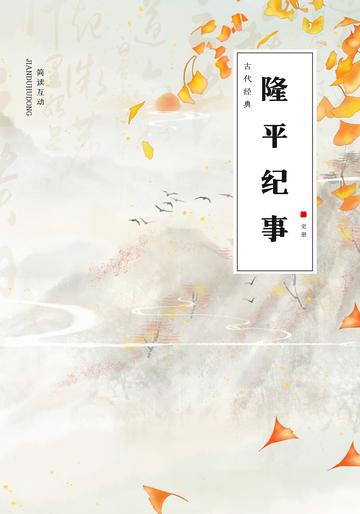
The Chronicle of Longping is a Qing dynasty work of historical notes, attributed to an author named Shice. It consists of one volume and belongs to the category of historical sources. It mainly records Zhang Shicheng's uprising at the end of the Yuan dynasty, the rise and fall of the Wu regime in the Jiangnan region, and the deeds of the people involved. With a concise structure and a focus on people and events, it uses a documentary style to describe Zhang Shicheng's uprising in Taizhou, the gathering of the eighteen members of the Righteous Society and their battles, as well as the full course of the Zhang brothers and their generals fighting to the death for the Zhang-led Wu regime. It offers a glimpse into the historical landscape of this turbulent era. The book also records social and cultural details, such as the Wu regime's esteem for men of letters, its courteous treatment of talented individuals, and the establishment of literary academies, providing indirect evidence for understanding the political and cultural climate of the time.
The first part focuses on Zhang Shicheng's rise and the background to his rebellion, depicting how he and his brothers swore an oath, took up arms, and built their power. The second part goes on to describe the institutions of the Wu regime, the gathering of scholars, the establishment of academies, literary exchanges, and the scholars who joined its ranks. Readers thus see not only military struggles, but also the cultural activities and social atmosphere of a wartime regime. The writing is straightforward, combining accounts of battles with biographies, administrative arrangements, and cultural narratives. This makes the work an important supplementary source for the study of popular uprisings and local regimes at the end of the Yuan dynasty.
For modern readers and academic researchers, The Chronicle of Longping is not only a valuable text for learning about Zhang Shicheng's uprising and the Zhang-led Wu regime, but also an important historical source whose details reveal the interplay of politics, warfare, and culture during a time of turmoil in ancient China. It helps readers gain a more comprehensive understanding of the complex dynamics of that historical period and is a useful resource for the study of military history, local regimes, and social and cultural history.