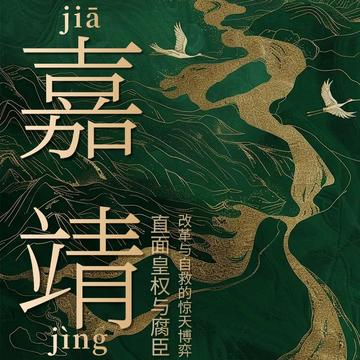
Focus on the reign of Emperor Shizong of the Ming Dynasty, Jiajing Emperor Zhu Houcong (1521-1566).
Taking time as its warp and major events and core figures as its latitude, it deeply analyzes the political situation and changes of the times during the forty-five years of the Jiajing Dynasty.
The work begins with the famous "Great Ceremony Meeting" incident, and details how the young emperor Zhu Houcong succeeded in defeating the old court system headed by Yang Tinghe through this political game that lasted for several years and laid the foundation for his absolute imperial power.
Subsequently, the book shows the Jiajing Emperor's efforts in governance in the early period, including a series of "Jiajing New Deal" measures such as rectifying officialdom, implementing reforms, building water conservancy projects, and strengthening border defenses.
However, in the middle and late period, Emperor Jiajing gradually indulged in Taoist fasting, pursued immortality, and neglected government affairs. This book uses a large amount of space to brilliantly reproduce how Yan Song and his son used this characteristic of the emperor to climb to the top of power during this period. They were dictatorial and chaotic for twenty years. During this period, there were fierce cabinet struggles (such as the power struggle with Xia Yan), major border crises (Gengxu Incident), and serious Japanese invasion in the southeast. In the end, through Xu Jie's forbearance, Yan Song's power fell, but the dynasty was hard to come back.
The book ends with Hai Rui's tragic act of risking his life to write "Public Security Shu" and the end of Emperor Jiajing's obsession, which profoundly reveals the root of the dynasty's systemic crisis.
The narrative is rigorous and the historical materials are rich. It not only vividly depicts the multiple personalities and complex features of Emperor Jiajing, but also three-dimensionally presents the fate of famous officials such as Zhang Cong, Xia Yan, Yan Song, Xu Jie, Qi Jiguang, and Hai Rui. It is a masterpiece that systematically interprets the Jiajing Dynasty and understands the process of the Ming Dynasty from prosperity to decline.