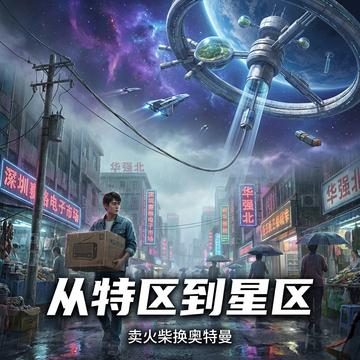
1987, Shenzhen Special Economic Zone (SEZ).
At the Luohu Port in a torrential downpour, a young man named Lin Yinuo dragged two woven sacks full of smuggled telephone switches across the border, beginning the adventure that was his alone.
“Noah,” the company he founded, started out as a “grey-market trading” outfit that could go under at any moment. To survive, they ventured across Siberia's frozen wilderness and through war zones in Africa, growing like weeds in the narrow gaps left by European and American giants.
But the wheels of history never stop turning.
After thirty years, Noah had finally planted communication base stations in every corner of the world when an iron curtain descended from a superpower.
Chip supplies were cut off, their systems were blocked, and their executives were detained.
On the brink of life and death, Lin Yinuo made a decision: they would no longer just adapt to their environment. They would change it.
From 2026 onward, Noah was no longer a communications company.
They built fusion batteries, solving Earth's energy crisis.
They completed a space elevator, propelling humanity into deep space.
They awakened MOSS, giving artificial intelligence self-awareness.
2050, the Alpha Centauri Sector.
Eighty-three-year-old Lin Yinuo stood before a “port” once again.
This time, however, the distance he had to cross was not the Luohu Bridge, but the 4.22 light-years of deep space.
He would lead humanity to establish what might be the first interstellar special economic zone in the Milky Way.