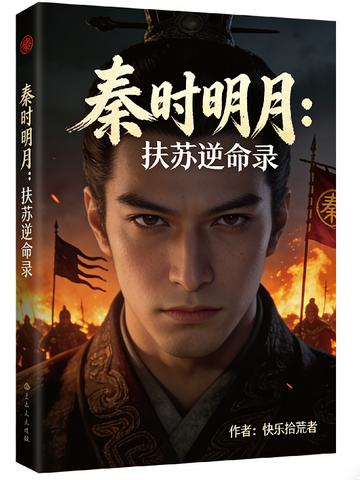
Chen Yan, a doctor of history, was robbed by lightning because he was repairing the Fusu Jade Seal. His soul traveled to Xianyang in 215 BC and became the 20-year-old eldest son of the Qin Dynasty. Faced with the fall of Hu Hai and Zhao Gao's assassination plot, he used modern thinking to reconstruct the historical trajectory: he implemented the "Classics Collation Department" in the court to preserve the cultural fire, improved ordnance at the border fortress to train Xuanjia Guards, and even shook the foundation of Qin's political power with technological innovations such as "cement paving" and "replacing farmland to increase production."
When the false edict of the Sand Dune Incident came, Chen Yan exposed Zhao Gao's conspiracy in public and led 300,000 Great Wall troops to clear the emperor's side. During the struggle between Chu and Han for hegemony, he broke the "black and white" historical narrative: after the Hongmen game with Liu Bang, he was crowned the King of Han, and in the Battle of Gaixia he used "New Ballads of the Chu Land" to disintegrate Xiang Yu's military morale, and finally established the "Hua Dynasty" that integrated prefectures and counties with enfeoffments. But a greater crisis is quietly approaching - a Roman mission speaking Mandarin appears in the Western Regions, a jade seal prophecies about a rift in time and space, and the fragments of "Historical Records" in Zhang Liang's hand record that Fusu, who was supposed to be dead, was among the "rebellious ministers and traitors".
This is a dialogue between a historian and an emperor through the ages. It is a fierce collision between modern civilization and the Bronze Empire. When the flames of burning books and humiliating Confucians turn into the ignition of technological innovation, when Gaixia's lament turns into the clarion call for institutional restructuring, let's see how the time-travelers find an unprecedented imperial path amidst historical inertia and personal ambition.