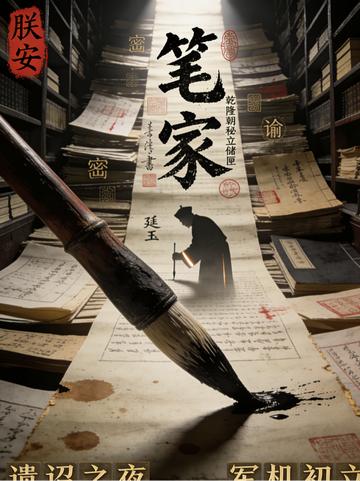
"Bi Zhong: Zhang Tingyu and the Secret Files of the Qing Court" is a million-word historical novel that uses "clerical politics" as a knife to dissect the core of power in the three dynasties from Kangxi to Qianlong. It does not describe the smoke of the battlefield, nor depicts the secrets of the palace. It only focuses on the "nerve endings" of the empire's operation - memorials, secret edicts, archives and inscriptions.
The protagonist Zhang Tingyu, the only Han official in the Qing Dynasty who was worthy of enjoying the Imperial Ancestral Temple, played the role of the "chief secretary" of the empire throughout his life. From the shocking posthumous edict of Emperor Kangxi in his later years, to the birth of the Yongzheng Dynasty's military department and the weaving of a dense network, to the strife and reckoning between the old and the new in the Qianlong era, through the ups and downs of the pen in his hand, we get a glimpse of how the supreme imperial power flows through ink, and we get a glimpse of a Han official climbing and falling on thin ice in the power structure of the Qing Dynasty.
This book combines the suspense of a limited-time mission with the texture of a micro-historical perspective. It uses key scenes such as "The Night of the Imperial Edict", "The Initial Establishment of the Military Plane", "The Sharing Puzzle" and "The Literary Prison Network" as anchor points to peel back layer by layer the institutional operation and the game of human nature under the aura of the prosperous age. This is both a technocratic epic of tragedy and joy, and a profound allegory about how "systems create people and ultimately devour their creators." In the silent depths of the pile of old papers, history sends out its most real and complex echo.