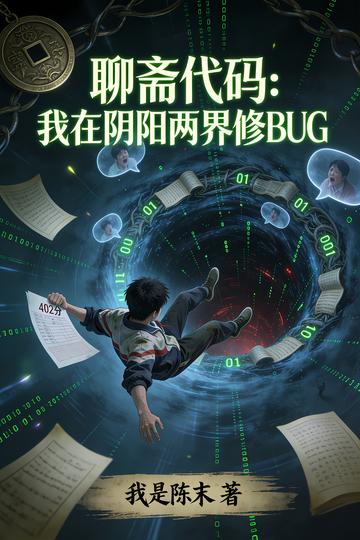
Chen Mo, who failed the college entrance examination three times, jumped from the top of the teaching building, but did not fall to the ground. He fell into the BUG gap between Yin and Yang.
He was selected by Xin Shiniang in "Strange Tales from a Chinese Studio" to become a temporary Yin-Yang BUG repairman - the underworld system was full of loopholes due to human technological interference and population explosion. His failure in the college entrance examination and his parents' car accident were all caused by system bugs.
Chen Mo signed a contract, and within the limit of 72 hours of Yang life, he could travel through dangerous places such as the Eighteen Hells and the Five Elements Palace. In his first battle in the Tongue Pulling Hell, he repaired Lu Jian's tampered logic chip, but accidentally triggered the Blood Tongue Devil's escape crisis, and was forced to undergo three years of hard training in the Jinxing Palace through the "Jinmu Clash".
Returning to the human world to trace the truth about his parents' car accident, Chen Mo discovered that there was a mysterious "entropy" organization hidden behind it - they tampered with the judge's chip, created unjust cases, and attempted to release the source of chaos in the Yin and Yang worlds. As the investigation deepens, Chen Mo reveals the secret of his family: The Chen family is the "lawful people of yin and yang" that has been passed down for thousands of years, guarding the tomb of the god that seals the outer gods.
From the Fengdu Ghost City to the Rakshasa Sea City, from Penglai's strange fog to the painted wall space, Chen Mo gathered legendary figures such as Nie Xiaoqian and Yan Chixia to fight against the elders of the Entropy Organization and integrate fragments of the godhead such as chaos, death, and time.
However, the conspiracy of the Entropy Organization is far beyond imagination. Their goal is to open Guixu and return the Three Realms to chaos. What's even more frightening is that there is an internal agent of the Entropy Organization hidden around him, and beneath the tomb of the gods, there is an even older and terrifying existence sleeping.
Can Chen Mo gather all the nine gods to prevent Guixu from opening? Where will the fate of him and Xin Shiniang go?
Reader comments
This story begins with the strong conflict setting of "a loser in the college entrance examination jumps off a building and triggers a BUG in the underworld system", combining the classical mythological foundation of "Strange Tales from a Chinese Studio" (Xin Shisi Niang, Eighteen Levels of Hell, Lu Pan) with modern "system tasks" and "data tampering". "The seamless integration of elements such as "electronic forensics" not only retains the charm of oriental fantasy, but also creates a game-like refreshing framework through mechanisms such as "Yangshou Timer" and "Knowledge Exchange". The world view is novel and logically closed, making it easy for readers to have a sense of immersion.
The plot advancement is efficient and interlocking: from Chen Mo accepting the restoration task and using modern knowledge to solve the problem of the Navy's judgment, to joining forces to fight against the Blood Tongue Demon and revealing the secret of "human injustice corrodes the seal of hell", each plot advances the main line of "the mastermind behind chip tampering", and is interspersed with the resource game of "Yangshou consumption and acquisition" and the ability growth of "spell learning and actual combat". The conflict density is high and there is no sense of procrastination.
The character creation is also noteworthy: Chen Mo's transformation from desperate death to fighting for resurrection and correcting the fate of his parents is clear and powerful; Xin Shisi Niang is cold and powerful but conceals tenderness, Lu Bian's forbearance and vigilance under his majesty are hidden foreshadowing, and the character's actions are all supported by motives. What's even more rare is that the story uses settings such as "Internet rumor punishment" and "human law affects hell" to connect the fantasy plot with real social issues, making "fixing system bugs" not only a matter of personal survival, but also implicitly discussing "justice", adding a layer of depth to the refreshing story.
Overall, this is an opening chapter that combines "setting appeal", "plot excitement" and "thickness of conception". The suspense (the mastermind behind the scenes, the forces in heaven) and the growth line are parallel, which can effectively attract readers' interest in continuing to follow the novel.
This story is based on the core setting of "a loser in the college entrance examination is involved in the repair of bugs in the underworld system after his death". It cleverly combines Eastern mythology (Xin Shisi Niang in "Strange Tales from a Chinese Studio", Eighteen Hells) and modern elements (system tasks, data tampering, electronic evidence collection) to construct a yin and yang worldview that is both absurd and full of logic. The setting is novel and self-consistent, and can quickly grab the attention of readers.
The plot progresses at a tight pace, from Chen Mo jumping off the building to trigger the bug, to accepting the repair task, contacting the land judge, and dealing with the crisis of the Blood Tongue Demon. Each event not only promotes the main line (investigating the mastermind behind the chip tampering), but also accompanies the growth of abilities (unlocking spells, increasing permissions) and the game of Yangshou resources. The sense of conflict progresses layer by layer, and there is no redundant plot.
There are also highlights in the character creation: Chen Mo's growth arc is clear from dying in despair to fighting for resurrection and correcting his destiny; Xin Shisi Niang is cold and powerful but has a hidden stance, and Lu Bian's forbearance and vigilance under the majesty of Lu Bian all pave the way for the story. In addition, the setting of "Injustice in the world affects the seal of hell" links the crisis in the underworld with real social problems (online rumors, judicial injustice), giving the fantasy story an extra layer of metaphor for reality and enhancing the depth of the content.
Overall, the story is both exciting (mission rewards, ability upgrades) and suspenseful (the mastermind behind the scenes, celestial forces), and the reality mapping under the fantasy framework also makes the content more weighty. It is an opening story with online rhythm, setting, and conception.
This story begins with the strong conflict setting of "a loser in the college entrance examination jumps off a building and triggers a BUG in the underworld system", combining the classical mythological foundation of "Strange Tales from a Chinese Studio" (Xin Shisi Niang, Eighteen Levels of Hell, Lu Pan) with modern "system tasks" and "data tampering". "The seamless integration of elements such as "electronic forensics" not only retains the charm of oriental fantasy, but also creates a game-like refreshing framework through mechanisms such as "Yangshou Timer" and "Knowledge Exchange". The world view is novel and logically closed, making it easy for readers to have a sense of immersion. The plot advancement is efficient and interlocking: from Chen Mo accepting the restoration task and using modern knowledge to solve the problem of the Navy's judgment, to joining forces to fight against the Blood Tongue Demon and revealing the secret of "human injustice corrodes the seal of hell", each plot advances the main line of "the mastermind behind chip tampering", and is interspersed with the resource game of "Yangshou consumption and acquisition" and the ability growth of "spell learning and actual combat". The conflict density is high and there is no sense of procrastination. The character creation is also noteworthy: Chen Mo's transformation from desperate death to fighting for resurrection and correcting the fate of his parents is clear and powerful; Xin Shisi Niang is cold and powerful but conceals tenderness, Lu Bian's forbearance and vigilance under his majesty are hidden foreshadowing, and the character's actions are all supported by motives. What's even more rare is that the story uses settings such as "Internet rumor punishment" and "human law affects hell" to connect the fantasy plot with real social issues, making "fixing system bugs" not only a matter of personal survival, but also implicitly discussing "justice", adding a layer of depth to the refreshing story. Overall, this is an opening chapter that combines "setting appeal", "plot excitement" and "thickness of conception". The suspense (the mastermind behind the scenes, the forces in heaven) and the growth line are parallel, which can effectively attract readers' interest in continuing to follow the novel.
This story is based on the core setting of "a loser in the college entrance examination is involved in the repair of bugs in the underworld system after his death". It cleverly combines Eastern mythology (Xin Shisi Niang in "Strange Tales from a Chinese Studio", Eighteen Hells) and modern elements (system tasks, data tampering, electronic evidence collection) to construct a yin and yang worldview that is both absurd and full of logic. The setting is novel and self-consistent, and can quickly grab the attention of readers. The plot progresses at a tight pace, from Chen Mo jumping off the building to trigger the bug, to accepting the repair task, contacting the land judge, and dealing with the crisis of the Blood Tongue Demon. Each event not only promotes the main line (investigating the mastermind behind the chip tampering), but also accompanies the growth of abilities (unlocking spells, increasing permissions) and the game of Yangshou resources. The sense of conflict progresses layer by layer, and there is no redundant plot. There are also highlights in the character creation: Chen Mo's growth arc is clear from dying in despair to fighting for resurrection and correcting his destiny; Xin Shisi Niang is cold and powerful but has a hidden stance, and Lu Bian's forbearance and vigilance under the majesty of Lu Bian all pave the way for the story. In addition, the setting of "Injustice in the world affects the seal of hell" links the crisis in the underworld with real social problems (online rumors, judicial injustice), giving the fantasy story an extra layer of metaphor for reality and enhancing the depth of the content. Overall, the story is both exciting (mission rewards, ability upgrades) and suspenseful (the mastermind behind the scenes, celestial forces), and the reality mapping under the fantasy framework also makes the content more weighty. It is an opening story with online rhythm, setting, and conception.