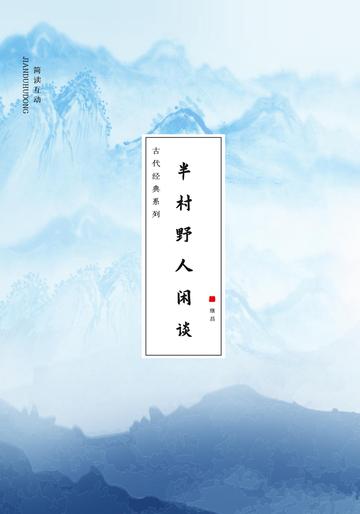
Casual Talks of a Rustic from Banchun is a Ming-dynasty work of historical notes and miscellaneous writings. Its author was Jiang Nan, courtesy name Shuming and pen name Rongtang, a native of Renhe, Zhejiang, and a successful provincial candidate in the fourteenth year of the Zhengde reign. The book consists of a single volume and belongs to the genre of notes in which Ming literati collected institutions and regulations, anecdotes about historical figures, and curious tales from the past. It is an important notebook included in catalogs of ancient works such as the Complete Collection of Ming and Qing Texts. Written in an informal, conversational style, it contains numerous short entries on ancient politics, law, rumors about notable figures, customs, anecdotes, and examinations of historical allusions. It combines documentary accounts in the traditional historical style with the author's personal observations and opinions, making it an old text that blends historical source material with the literary notebook tradition...
Rather than following a continuous narrative, the book presents scattered entries on a range of subjects, from punishments in ancient law and personal anecdotes to historical commentary and social customs. For instance, it records debates on criminal law, the history of cities and fortifications, and stories about famous figures. These entries reflect the author's interest in ancient institutions and regulations, as well as his keen eye for historical details and human nature. Thanks to its flexible form, the book offers a distinctive perspective for studying historical institutions and intellectual currents in the Ming dynasty and earlier periods, and is also an important text for understanding Ming notebook literature and refined tales and conversations.
The book survives in several editions, many of them printed in the Qing dynasty, and is held in various collections of rare books. It remains an important reference for later scholars studying ancient Chinese notebooks, miscellaneous historical sources, and the practice of history among Ming literati.