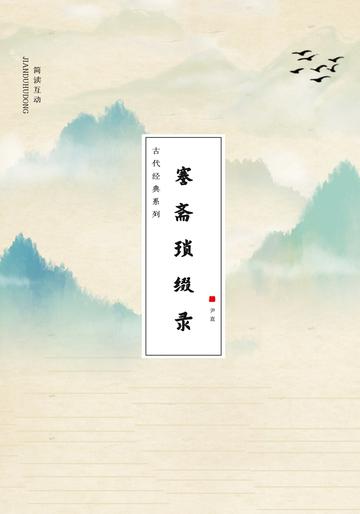
"Jian Zhai Suo Zhu Lu" is a miscellaneous historical material written by the Ming Dynasty scholar Yin Zhi (Zhengyan, born in Taihe, Jiangxi, 1427-1511). The book has about eight volumes and is an important part of ancient notebooks and miscellaneous records. Yin Zhi had a rich official career. He was a Jinshi, a Hanlin scholar, and a minister of the Ministry of War. He was a highly valued scholar and official in the mid-Ming Dynasty. Many of his works have been handed down, and "Jian Zhai Suo Zhui Lu" is one of the important works that combines his experience and historical knowledge.
This book is in the form of miscellaneous notes, covering a wide range of matters including court politics, official anecdotes, institutional regulations, banquet etiquette, anecdotes of famous officials, and anecdotes that the author personally experienced or heard about in the Ming Dynasty. It is a precious material that supplements historical details beyond the official chronicle. Different from the official history compiled by the government, it is not limited to systematic narratives, but is presented in the form of entries, short notes and fragments, including descriptions of historical events, as well as the author's comments and value judgments. Such notes play an important role in the historical tradition of the Ming Dynasty and can reflect the reflection and memory of the political culture and social phenomena of the scholar-bureaucrats at that time.
"Jian Zhai Suo Zhui Lu" not only provides detailed circumstantial evidence on the dynamics of officialdom, power struggles and cultural customs in the mid-Ming Dynasty, but also provides an entry point for understanding contemporary characters' personalities and social ecology through specific details and personal observations. It is not only suitable for academic circles to use as supplementary historical materials, but also allows readers who are interested in ancient Chinese history, notebook literature and cultural history to get a glimpse of the diverse aspects of politics and culture in the mid-Ming Dynasty through notebook-style fragmentary narratives.