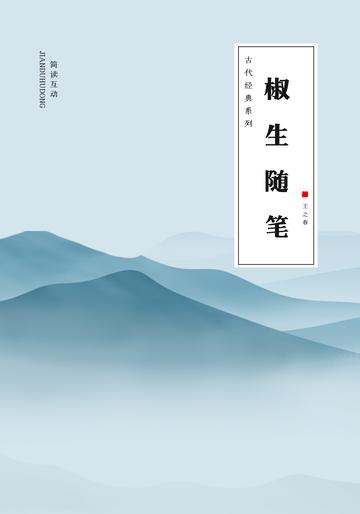
"Jiao Sheng Essays" is an important notebook-style work written by the Qing Dynasty scholar Wang Zhichun (also known as Juetang, also known as Jiao Sheng). The book has eight volumes and is a collection of his essays during the turbulent years of the late Qing Dynasty. The content of the book draws from many sources, including keen observations of the political situation at the time and anecdotes between the government and the public, as well as vivid descriptions of anecdotes, scenery and people. It also touches on various topics such as poetry, calligraphy and painting, and presents the profound cultural accumulation and unique insights of an official in the late Qing Dynasty.
Wang Zhichun himself was a politician and diplomat in the late Qing Dynasty. He served as governor and envoy to Russia and other important positions. He personally experienced major historical events such as the Taiping Rebellion and the Sino-Japanese War of 1884-1894. Therefore, his notes were not only interesting remarks by scholars, but also recorded the political atmosphere and social changes of that era. The essays in the book are mostly short, concise, and uniquely insightful. They include allusions and anecdotes, as well as comments on current affairs and personal insights, showing that the author can write about "elegant topics" and analyze real-life issues from a dual perspective.
As a document from the late Qing Dynasty, this notebook is not only an important material for understanding Wang Zhichun's personal thoughts and life anecdotes, but also provides valuable first-hand information for studying the official culture, diplomatic history and social customs of the late Qing Dynasty. Whether for history lovers or readers interested in traditional culture, "Jiao Sheng Essays" has high reading value and reference significance. The wisdom and humor revealed in its words are enough to give people a glimpse of the inner world of a "Westernizationist" official in the stormy era.