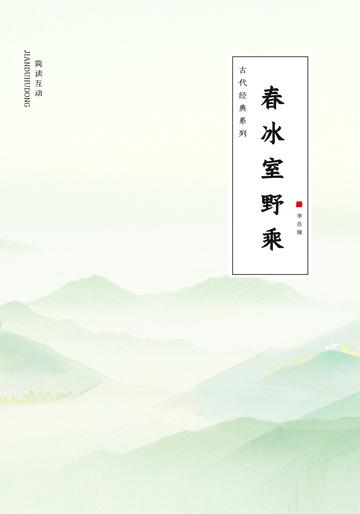
Chun Bingshi Yecheng is one of the most renowned historical works in the biji note-taking style by the late Qing scholar Li Yuerui, whose courtesy name was Mengfu. The book comprises around 143 entries, using a concise, refined style to recount court affairs, officialdom's hidden stories, anecdotes about notable figures, and aspects of social life in the Qing dynasty. Writing with the touch of a historian, the author does not confine himself to the rigid conventions of official histories. Instead, through specific incidents and details, he brings to life the many layers of Qing society. The material ranges from stories about the reigns of the Qianlong and Yongzheng emperors and palace intrigues to literary amusements, the many faces of officialdom, tales of wandering knights, and anecdotes from the world of the arts. Rich and vivid, the book has both historical value and great appeal as reading. Its incisive observations of the rise and fall of officials are interwoven with allusions to historical figures, poetry, and prose, giving readers both historical records and a taste of the elegance and reflection behind the writing.
Li Yuerui was an official and scholar who passed the highest imperial examination in the late Qing. He served as a Hanlin Academy compiler and a vice director in the Ministry of Works, among other posts, before devoting himself to editing historical works and writing biji notes. He was deeply influenced by the literati traditions of the late Qing. His historical notes not only preserve many entertaining anecdotes absent from official histories, but also combine personal historical judgments with cultural reflections, securing an important place for him in the Chinese tradition of biji literature. Because Li Yuerui's accounts are concise and his comments judicious, his works are often cited by later historians and scholars, making them important sources for the study of Qing history and society.
For modern readers, Chun Bingshi Yecheng is not only a classic that broadens one's historical horizons, but also a cultural window into the world of the Qing dynasty. It strikes a balance between historical documentation and literary merit, allowing readers to enter the past while experiencing the storytelling wisdom and spirit of the age. It is a rewarding read for anyone interested in Chinese history and biji literature.