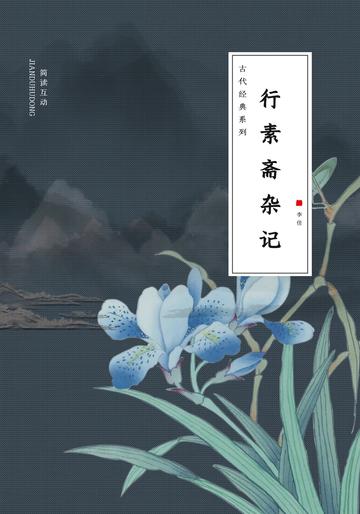
"Xingsu Zhai Miscellaneous Notes" is a precious historical material written by Li Jia in the Qing Dynasty. Its full name is "Xingsu Zhai Miscellaneous Notes". It is collected in two volumes. It was printed in the 27th year of Guangxu's reign in the Qing Dynasty (1901) and is now in the Tianjin Museum and other collections. This book is not an ordinary miscellany of notes, but a fragmentary account of old military news of the Qing Dynasty, the evolution of the official system, official anecdotes and personal deeds compiled by the author based on years of experience and study. It can be called a microscopic observation record of officialdom and social life in the late Qing Dynasty.
The author Li Jia, also known as Jichang, was a Jinshi in the Qing Dynasty and served as a military officer, Zhang Jing, etc. Most of what he saw and heard came from personal experience and observation, so the content in the notes has a sense of record. It not only summarizes the major institutional changes, but also presents vivid descriptions of political etiquette, official details, and the imperial examination system at that time. "Xingsu Zhai Miscellaneous Notes" contains records of important court events, as well as local customs and social anecdotes. In particular, it describes the operation of the Qing government, the inside story of the Military Aircraft Department, and even fragments of the lives of scholar-bureaucrats. It allows modern readers to feel the true appearance of officialdom and society at that time through trivial accounts.
Different from traditional official history, this miscellaneous note emphasizes details and personal observations, with simple language and rich content. From royal etiquette, details of the examination room to interesting stories about interactions between scholars, it all reflects the style and character of the times. It is an important source material for studying the political culture, official system and social customs of the late Qing Dynasty. It also provides readers who are interested in Qing society with a relaxed but in-depth historical perspective.