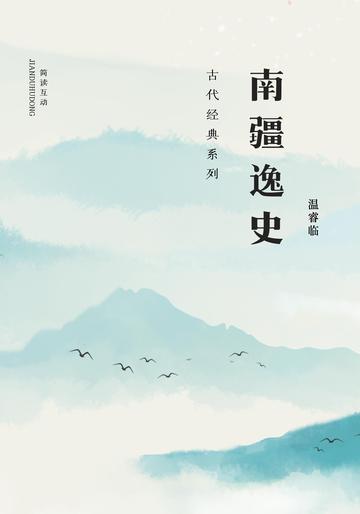
"A History of Southern Xinjiang" is a large-scale biographical history book written by the Qing Dynasty historian Wen Ruilin. It is an important document in the history of the Southern Ming Dynasty. It specifically records the major events and biographies of the Southern Ming regime during the Hongguang, Longwu and Yongli dynasties. This book was originally called "The Anonymous History of Southern Xinjiang". After being sorted and supplemented, it formed a complete system. It was compiled and edited by later generations and circulated in the historical circles in different volumes. The book consists of two parts: chronicle and biography, with a total of ten volumes. It is a rare first-hand historical material for studying the Ming and Qing dynasties, the anti-Qing movement in the Southern Ming Dynasty, and the history of national struggle.
The compilation style of this book is a biographical history book, which contains not only descriptions of major events, but also detailed descriptions of characters' experiences, deeds and characters. Wen Ruilin collected various early unofficial historical materials such as "Sui Kou Chronicles" and "Records of Loyalty and Martyrs in the Late Ming Dynasty" to summarize various historical fragments before and after the fall of the Southern Ming Dynasty. He also used logical sorting and historical judgment to make this work have both historical value and historical significance. The book not only describes the process of the Southern Ming court officials and generals' resistance against the Qing Dynasty, but also adds supplements to many characters and events that are insufficiently recorded in the official history, allowing readers to see a complete and three-dimensional picture of the times.
As an important supplementary historical text on the history of the Southern Ming Dynasty, "A History of Southern Xinjiang" has extremely high historical value for studying the political structure, military resistance, ethnic relations and social mentality during the replacement period of the Ming and Qing Dynasties in China. Through this work, modern readers can have a deeper understanding of the establishment and decline of the Nanming regime, the trajectory of the resistance against the Qing Dynasty, and the fate of diverse historical figures in that turbulent era.