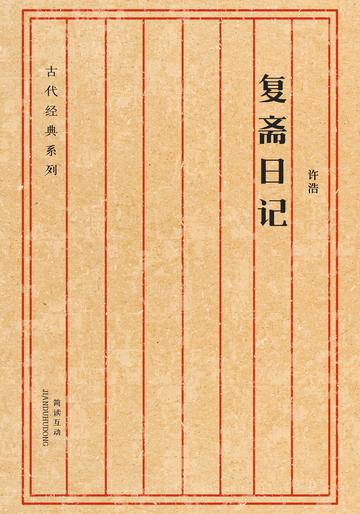
Fu Zhai Diary is a collection of historical notes from the Ming dynasty, written by Xu Hao and completed in 1495, the eighth year of the Hongzhi reign. Originally titled as a work recording the author's daily observations and historical events, it belongs to the diary and historical-notes genre. The book is about two volumes long, and the earliest surviving printed editions appear among old editions published by institutions such as the Commercial Press. Writing in the first person, Xu Hao records daily life, observations of political affairs, anecdotes about notable people, and literary historical material. Its style falls somewhere between a private diary and a collection of historical notes, offering the author's firsthand observations of people and events of his time. The book is also known as Records of Conversations by the Two Lakes. In his preface, the author says he wrote it to record his observations and fill gaps in the historical record. Its format resembles Ye Sheng's Water-East Diary, though their contents and emphases differ.
The book covers political affairs and customs of the time, the social circles of cultural figures, and literary historical material. For example, it briefly records and comments on the lives and works of literary figures such as Fan Zhongyan, Wang Mian, and Gao Qi. It also includes many entertaining fragments that shed light on the social interactions and customs of scholars of the time. Such fragmentary, concrete accounts are often absent from official histories, and their diary-like presentation provides precious firsthand material for studying the customs, politics, and cultural figures of mid-Ming society.
Overall, Fu Zhai Diary is more than a collection of private notes: it fills gaps in official histories' accounts of certain people and events, allowing later generations to glimpse the many facets of Ming society through the details of everyday life. It is an invaluable source for researchers of history, literary history, and cultural history.