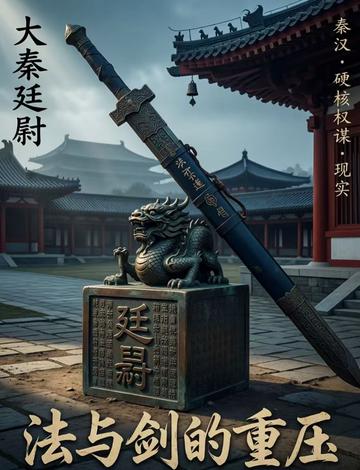
In the first year of Qin II, on the eve of the collapse of the empire.
Meng Tian was sentenced to death, and the 300,000 elite members of the Great Wall Legion became bargaining chips for the powerful.
**Li Ke**, a low-level official in charge of grain and grass management, had no military talismans in his hands, only a volume of "Qin Law" and a diary for calculation.
Faced with the coach who was greedy for military pay, he did not draw his sword, but started a "pre-military audit" event.
Using "Laws of Imitation" as a sword, he used arithmetic to set up a trap and put the commander into a deadlock, forcing the three thousand captains to "mutiny in accordance with the law" in order to survive.
**The law orders people to kill, which is an exhaustive strategy. **
When King Qin's edict came from Xianyang, 400,000 wolves riding on the grassland closed the gate.
Should he go south to save the corrupt Qin court, or go north to protect the backbone of China?
Li Ke calculated all the food and grass, calculated all the people's hearts, and finally forged an edict. Bearing the reputation of a "Qin thief", he carried out the most cold-blooded "resource exchange" massacre in Yinshan with the lives of 300,000 people.
"What I save is not the Qin Dynasty, but the thousands of Guizhou heads behind the Great Wall."
**This is not only a historical novel, but also a rigorous logic problem. **
From keeping accounts to survive, to calculating the destiny of the country.
Let's see how the last court captain of the Qin Dynasty used absolute rationality to bring a bloody end to that magnificent era.