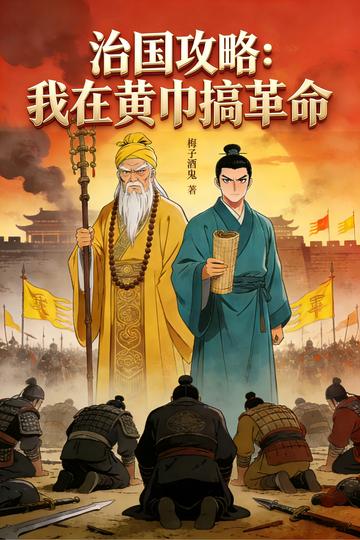
Chen Qi, a young scholar in the Party History Research Office of the Communist Party of China, accidentally traveled to Jizhou in the fourth year of Guanghe in the Eastern Han Dynasty (AD 181), and became a poor scholar with a poor family, well-read poetry and books, but extremely disappointed with reality. While on the run, by chance, he got acquainted with Zhang Jiao, who was using "Fu Shui" to treat diseases among the people and spread "Taiping Dao" ideas, and was bound to the "Civilized Fire System". Knowing that the Yellow Turban Uprising ended in failure in the original history, did he choose to adapt to history, or did he try to open up a new path with new "tinder"?
He promulgated the "Three Major Disciplines and Eight Points of Attention", set up a "meeting hall" where people could express their opinions and discuss matters, implemented "household registration and equalization of the people", registered land and population, allocated wasteland, promoted potato seeds and compost, built water conservancy, public-owned blacksmith shops and hospitals, opened "literacy classes", and incorporated the concepts of equality and labor.
In this historical time and space, he competed with Cao Cao, Liu Bei, Sun Quan, Dong Zhuo and others. With his deep understanding of history and the integration of modern governance concepts, Chen Qi quietly set off a storm of change in this land...
Reader comments
The pace is tight and the plot is interesting! [Eat melon][eat melon]
The pace is tight and the plot is interesting! [Eat melon][eat melon]