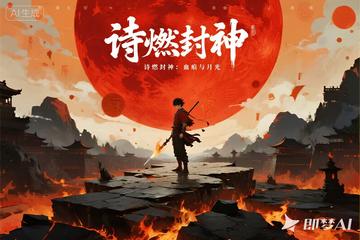
When the wind of Chaoge lifts the curtains of Nuwa Palace, Yanshan's Lei Tuo raises its new wings, and in the twilight of the Shang and Zhou dynasties, a chess game involving humans, gods and monsters quietly takes place. "Poetry to Confer Gods" breaks out of the traditional narrative framework of gods and demons, uses a modular modern structure to dismantle the puzzle of fate, and uses poetic imagery to touch the texture of human nature, giving the three-thousand-year-old legend a fresh power that reaches the present.
Abandoning linear narrative, the core conflict unit is the boundary game between gods and humans, family affection and power intrigue, resistance and fate entanglement. It is both independent and connected by the hidden thread of "fate", which fits the fragmented reading habit and keeps the story intact. The text refuses to reproduce ancient texts, and uses concise metaphors such as "the bones of loyal people are softened by the wine pond and the meat forest" and "Ji Chang carved two thousand five hundred and fifty-five rays of moonlight" to give the traditional image a modern texture. The poems are interspersed to purify the emotions, forming a dual expression of "narrative + poetry".
Breaking the black-and-white stereotype: King Zhou is the "lonely one in the clouds", with greed hiding behind the lack of power; Daji is the "silent person in the storm", who is coerced by destiny under the bewildering king; Jiang Ziya is the "one who overcomes the tribulations of the mortal world", hiding confusion and persistence in waiting. The exploration of the grayscale of human nature gives the character an emotional background that resonates at the moment.
It turns out that becoming a god is not a one-man show between gods and demons, but a grand breakthrough of human nature in the chess game of destiny. The gentleness under the armor and the perseverance in desperate situations, after three thousand years of wind and rain, still touch the weakest point of people's hearts.
Reader comments
A unique poetic novel that sees a different kind of apotheosis of gods and the human nature stripped away from divinity.
A unique poetic novel that sees a different kind of apotheosis of gods and the human nature stripped away from divinity.