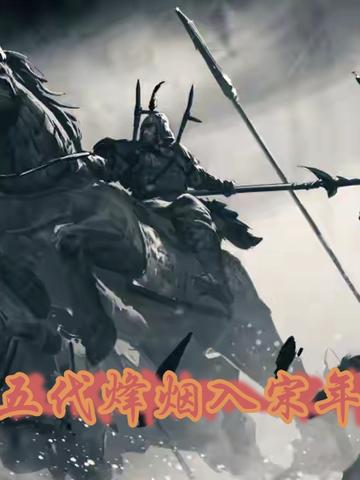
When the salt seller raised his pole and the fire lit up the Zhuque Gate in Chang'an, young Li Sanlang didn't know that he would become a living history book of the Five Dynasties and Ten Kingdoms.
From the ignorant pawns of Huang Chao's uprising army to the struggling surrender of Zhu Wen's troops; from the small official who governed the vassal town in the later Tang Dynasty to the bloody veteran of the Forbidden Army in the later Zhou Dynasty - he experienced the three falls of Chang'an and the burning of the palace in Luoyang. The dragon flags of the Liang, Tang, Jin, Han and Zhou dynasties were changed one after another before his eyes, the horseshoes of the Shatuo cavalry crushed the Central Plains, and the Khitan's wail of "beating the grass in the valley" penetrated the Jianghuai River. But he always lived in the gaps of the troubled times: watching the actors regicide, watching the vassal town proclaiming the emperor, watching Chai Rong's sharp brigade drinking from the Mahuai River, and watching Zhao Kuangyin suddenly wearing a yellow robe.
When the white-haired Li Sanlang stood in the morning mist of Bianjing, looking at the vendors selling Hu cakes on Zhuque Street and the candidates waiting for the announcement of the results outside the Gongyuan, he suddenly realized that the bark chewed in Langhu Valley, the blood shed on the battlefield of Gaoping, and the city walls destroyed and rebuilt by the war, finally held up a new era in which the emperor was no longer judged by the strength of his soldiers and horses.
This is not a hero's legend, but an ordinary person's eyes recorded the beacon fires, cooking smoke and human hearts during the hundred years of chaos during the Tang and Song Dynasties - from the wind and rain in the late Tang Dynasty to the dim light in the early days of the Song Dynasty.