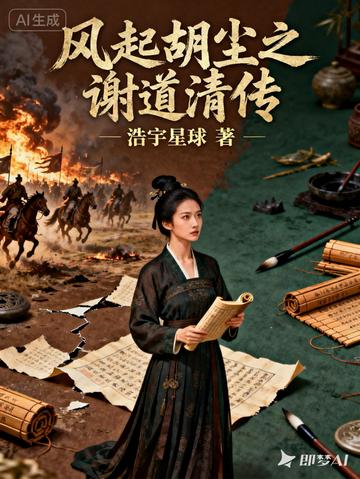
In the fifth year of Yongjia, the Huns' cavalry broke through the Luoyang city gate. The fire engulfed the century-old palace, and the splendor of the northern nobles' clothes was reduced to dust and smoke on the way to escape overnight.
Nineteen-year-old Xie Daoqing, the only legitimate daughter of the Xie family in Chen County, after almost all the male members of the family died in the war, what she received was not a dowry, but a camphor wood box that weighed more than a thousand pounds. Inside were the last classics that the family had saved with their lives during their migration southward: ten volumes of commentaries on the Book of Rites, seven ancient volumes of the Book of Songs, and the unfinished "Gu Lu of Wei and Jin Dynasties" written by her grandfather Xie Heng. Before his uncle died, he pressed the box key into her palm: "Dao Qing, Xie's cultural background, the fire of China, will be on your shoulders from now on."
The road to the south is a blood-stained road. She cut off her long hair, darkened her face, and mingled with the refugees. In order to protect a box of bamboo slips, he personally pushed the rebels who were trying to rob him into the turbulent water by the Huai River; he once dictated "Guan Guan Jiu Jiu" to children in the refugee shed where the plague was spreading; he also gave the last half of a cake to an old Confucian scholar who was traveling with him on a hungry and cold winter night, in exchange for him reciting half of the "Book of Music" that was about to be lost...
This is a trajectory that is almost buried in the dust of history: how a woman who has never been recorded in orthodox history books, with her flexible shoulders, became the thin but continuous line that connected the faults at the most fragile moment of civilization. When the yellow sands of the troubled times finally settled, her silhouette with her head buried in copying became the most silent and tenacious footnote of that dark era.
And the fire she protects will eventually illuminate this vicissitudes of land again at some dawn in the future.