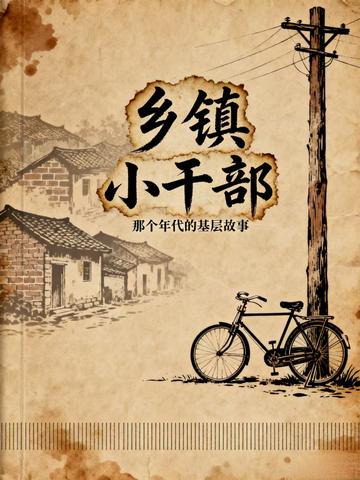
A Small-Town Official
乡镇小干部
- Status
- Completed
- Length
- 331k Words
- Genre
- Urban
- Subgenre
- Urban Everyday
- Updated
- 8mo ago
- Source
- Fanqie
Synopsis
More by this author

In booklists 9

Tomato Newcomers Starting New Stories, Follow and Review Each Other, and I'll Return the Favor
Looking for books similar to "Thirteen Weeks to Doomsday". Are there any new authors like me, beginners with no readers? Come share your work. We can review, follow, and encourage each other. After you've reviewed mine, message me and let me know. I'll definitely return the favor ❛˓◞˂̵✧
Let’s Exchange Five-Star Reviews for Our New Books
I want to read something similar to Yin-Yang Tribulation: Seeking the Way. New author here. Come in for mutual reviews and five-star ratings, fair for everyone.
Novels Suitable for Older Readers
Books suitable for older readers to listen to.


Realistic Political Dramas
I’m looking for books like Lovers in the Officialdom: Storms Over Daping Township. Nothing that just makes stuff up to glorify things.



A Hollywood Bulldozer, You Decide
Looking for books similar to This Is the Hollywood I Want. @ClutchTheToad @Qiao Quankun @Mo Yu of Luoxian Lake @WhatDoIDoIfImOutOfBooks @DreamingOfTheFuture @Pigeon & Ayuan @DongliLovesCabbageAndPorkDumplings @Dui


New Writers, Recommend Any of Your Books Here

All the Rural Novels Have Been Taken Down. Any Good Recommendations?
I'd like books similar to "The Mountain Village (The Story of Wang Dachun)". I'm looking for rural stories with miracle doctors, ancient martial arts, cultivation, farming, and so on.

Bookworm Matchmaking Center
Looking for something similar to "Who Does the Eternal Beauty Bloom For?" Follow, comment, like, and keep reading. Open to collaborations. Give and take!



Out of Books? Look Here!
Looking for something like City of Time: The Invisible. It's by a new author, so I'm looking for feedback. Honestly, the writing isn't that great.
Reader comments 23
Translated by Google Translate
This novel is very grounded and has great literary and sociological value. It fills in the "middle zone" that is often blurred in mainstream narratives - how policies are understood, implemented, adapted and even recreated in the last mile; the real situation, state of mind and contribution of grassroots cadres in the historical process...
Reading this novel based on Mu Ziqi's ten years of grassroots experience, it's hard not to be struck by a solid "sense of presence." In Nanmiao Town in 1996, the salty sea breeze mixed with the heat wave of the saline-alkali land hit your face. The black locust trees in the town government compound were motionless, the blackened old tea in Qin Mufeng's tea vat, and the dirt between Li Xiaolan's fingernails all told you: This is not a floating officialdom cool article, but a history of grassroots governance with body temperature. What is commendable is that the novel does not create a hero, but restores a group of ordinary people "walking in the times". The intertwined destinies of these characters allow us to see that every small advancement in the torrent of the times embodies the hesitation, perseverance and wisdom of countless individuals. When the bell rings for the abolition of agricultural taxes, it is a collective upgrading of a generation in the transformation of rural China. This is a book that needs to be read with concentration. It has no dramatic conflicts and contains the code to understand the foundation of Chinese society. If you want to know "where we come from" and understand the true logic of grassroots governance, you might as well follow Mu Ziqi's footsteps and walk into the local memory that is not far away.
This is my first time reading a book with this kind of realistic theme. It's pretty good. Please keep updating.
This novel is about grassroots work in rural areas. The author shows us the complexity and diversity of grassroots work through delicate writing. In the process, he also makes the characters of various characters come alive, making it feel like they are alive.
Thank you for your support! Keep up the good work! The author uses the ten-year ups and downs of finance cadre Mu Ziqi as a prism to accurately reflect the pain and transformation of China's grassroots society from the 1990s to the beginning of the new century. There is no grand narrative in the book, but in the details of village struggles, family planning, and tax reform, it depicts the difficulties of policy implementation and the complex spectrum of human nature. It allows us to see that every advancement in the current of the times embodies the concrete hesitation, perseverance and wisdom of countless grassroots individuals. This is a must-read book to understand the foundations of Chinese society.
It is a very good novel. The author writes fluently and tells a story in a realistic way that is more suitable for real life. The plot is simple but vivid, with a strong sense of substitution and endless aftertaste after reading it. Recommended reading, you won't lose money if you enter the pit.
This novel is very grounded and has great literary and sociological value. It fills in the "middle zone" that is often blurred in mainstream narratives - how policies are understood, implemented, adapted and even recreated in the last mile; the real situation, state of mind and contribution of grassroots cadres in the historical process...
Taking the protagonist's ten years of ups and downs at the grassroots level as a microcosm, it vividly outlines a group portrait of grassroots cadres at the turn of the century who broke through the governance dilemma and persisted in the tide of the times, which is very realistic.
The content is so exciting and realistic. The details are well controlled in all aspects. It has a strong sense of age and immersion. I look forward to the follow-up.
This novel is very interesting. I haven't seen such an interesting novel in a long time. Come on, come on!