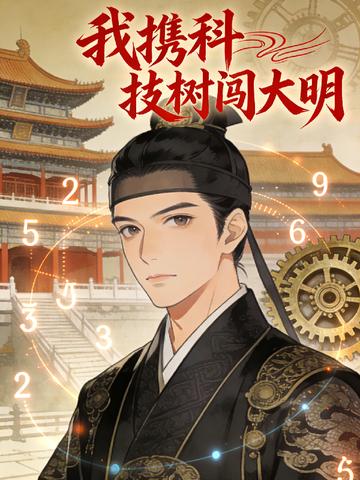
Lin Yuan, a modern PhD in engineering who also studied Chinese language and literature, transmigrates into Zhu Yuntong, the legitimate second son of Crown Prince Zhu Biao, in the twenty-fifth year of the Hongwu reign (1392). His mother is Chang, daughter of the Prince of Kaiping, Chang Yuchun, and Zhu Biao’s first wife. Zhu Xiongying, the legitimate eldest son, died young, making Zhu Yuntong the legal heir apparent’s eldest surviving son. By then, Zhu Biao and Empress Ma have both died, leaving Zhu Yuanzhang grief-stricken by the loss of his son and the court rife with intrigue over the succession. Government documents are plagued by the lack of punctuation, cumbersome wording, and inconsistent measurements. Corrupt officials exploit these flaws for personal gain, while members of the imperial family struggle with basic literacy and calculations.
The protagonist uses five tools to break through the impasse: punctuation, a pinyin system, simplified characters, Arabic numerals, and modern mathematical algorithms. He activates the “Great Ming Technology Tree System” and stays closely grounded in the real history of the late Hongwu era, including the aftermath of the Blue Jade case, the threat posed by the vassal princes’ military power, and incursions by the Northern Yuan and Japanese pirates. He lays the groundwork for the Industrial Revolution and major engineering projects, gradually advances technological innovation and public education, averts the Jingnan Campaign, rebuilds the foundations of the Ming Dynasty, breaks the dynastic cycle, and forges a powerful nation that will endure for a thousand years.