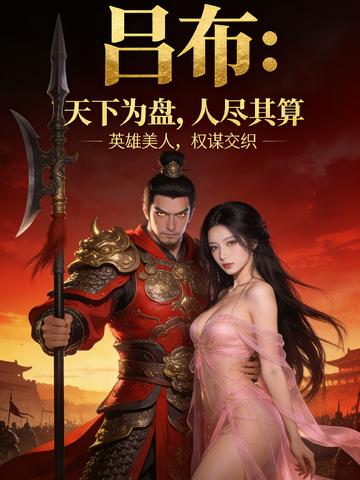
If Lu Bu is reborn with modern management thinking, he will not fight for the world, but to formulate the rules of the world.
Upstairs at the White Gate, a knife and ax are on the neck. Lu Ce, the director of modern strategy, traveled to Lu Bu in a desperate situation, but instead of begging for his life, he laid out a game matrix diagram: "Kill Bu, and you will gain a reputation; use cloth, and you will get a sharp weapon. Now that Yuan Shao is in power and Yuan Shu is in control, does Ming Gong want to make enemies on all sides?" A life-and-death negotiation based on modern game theory began.
This is not a traditional history of military conquest, but a silent "institutional revolution." The protagonist refuses to rely on advanced technology or personal bravery, and instead turns modern organizational management, game theory, and social psychology into a sword to break the situation. In Hanoi, he established a "military merit-production dual-track system", exchanging points for land and allowing soldiers to make crazy calculations for military merit; in Binzhou, he designed the "Hu-Han integration policy" and the "leveling warehouse economic system" to use rules to resolve hatred and use data to regulate food prices. The "Jinyang School" he founded did not teach classics, but only taught literacy, arithmetic and law, and trained the first batch of professional officials in the late Han Dynasty.
While Cao Cao, Liu Bei, and Sun Quan were fighting bloody battles in Chibi and Hanzhong, Lu Bu was building a "governing operating system" as precise as clockwork in the north: standardized army, secret intelligence network, quantitative assessment, process-oriented production... His core battlefield was not on the battlefield, but on the reshaping of people's hearts and systems. Chen Gong went from questioning to admiring, Zhang Liao transformed from a brave general to a professional officer, Diao Chan grew from a beautiful tool to an intelligence leader - everyone found new coordinates in this change.