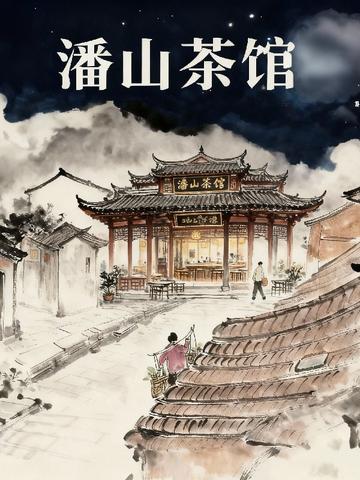
In the spring of the 23rd year of the Republic of China, Pan Shiming, the young master of the Pan family who returned from Southeast Asia, returned to Panshan Old Street in Quanzhou, hoping to find the ancestral "Xingyang Pan Stone Carvings" and uncover the territorial dispute between his family and the Lin and Gao families. Lin Xiuqing, the daughter of Lin Wende, the owner of Tingquan Teahouse, organizes patriotic youth gatherings with progressive ideas; Gao Qiwen, the young master of the Gao family, is ambitious and wants to build a warehouse to expand his power. The three major families are harmonious on the surface, but in fact there are undercurrents due to folk activities such as Qingming sacrifices, Dragon Boat Festival, and Mid-Autumn cake betting.
In Pudu in July, the "Pan Jie" stone carving was discovered on the mountain behind the Pan family's ancestral tomb. Under the clouds of war, news of the fall of Xiamen came. Gao Qiwen secretly colluded with Japanese businessmen, Pan Shiming contacted the guerrillas, and Lin Xiuqing organized women to support the front line. During the Dragon Boat Festival in the 28th year of the Republic of China, the Japanese army bombed Quanzhou and the Yunpan Bridge was blown up. The three major families joined forces for the first time. Based on the fragments of General Pan Jie's Art of War presented by Pan Shiming, they discovered the caves and secret passages where soldiers were hidden in the Tang Dynasty, and decided to find a secret passage to take refuge together.
In the 29th year of the Republic of China, the Japanese army invaded. The three major families put aside their grievances and jointly dug a secret passage. Gao Qiwen died to save Lin Xiuqing, Pan Shiming detonated explosives and died as a martyr, and Lin Xiuqing stuck to the teahouse. After the victory of the Anti-Japanese War, Lin Xiuqing wrote the stories of the three major families into a booklet and placed it in the teahouse. A new monument was added next to the Zhaoxian Well, with the names of the victims engraved on it. Tingquan Teahouse still smells the fragrance of tea, and Nanyin sings ancient memories and witnesses the never-ending story of Panshan.