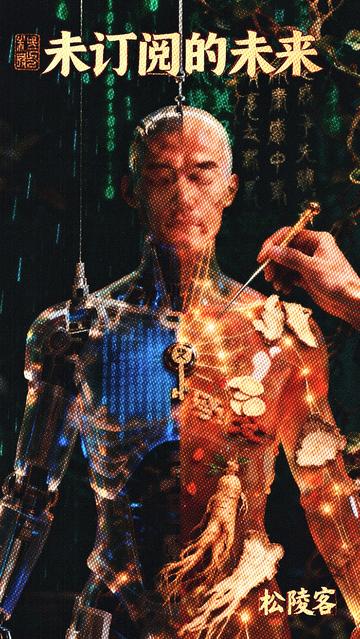
"The Unsubscribed Future"
System protocols weave an invisible giant web, and Zhenhe Town becomes a gentle exception. The loopholes of the seven solar terms are hidden deep here, and the seven emotional carriers who are "subscribed" to a lifetime are trapped in it - those who are worried are fishing alone in the cold river, those who are angry are watering the fields with sweat and blood, those who are happy are smiling with tears, and both joy and sorrow are nourishment for the system.
Lu Jibai holds the Tai Chi copper coin passed down by his father and can temporarily change the cold agreement. Su Ranchen carries the last butterfly vein of the demon clan, and enters the human world to avoid the Qing Dynasty. On a rainy night, a contractual marriage bound the two of them: he gave her identity cover, and she taught him the secret of illusion.
Living in the same room, secrets grow quietly. The backlash of acupuncture burned his shoulders, and the illusion peeled off her butterfly scales. When the tide of "clean AI" sweeps across the town, they stand side by side for the first time: Dieyi weaves through the cognitive fog, and Silver Needle hijacks the torrent of data to create a niche in the algorithm.
The dark pattern of the marriage contract is revealed under the moon:
"One person dies, and the other person bears the weight of the fragments."
"On the night of the full moon, exchange the secret that souls cannot lie."
The strange pupils of the cats reflect the man in black throwing himself into an ancient well. Thirty-three years ago, the bloody memory of the "Nuwa" laboratory reappears with the rain. They finally realized that each other was not only a name in the contract, but also the only coordinate in the sea of data.
The carrier of the seven emotions awakens, and the charge network surges. A marriage that started with a lie turned out to be the key to unlocking destiny. And love is the highest authority that they have never subscribed to but quietly takes effect.
Reader comments
"The Unsubscribed Future": A "System Self-Inspection Report" by an Internet Practitioner
Mr. Songlingke:
I finished reading your book in my office building in Zhangjiang, and the screen light reflected on my coffee at two o'clock in the morning. As someone who writes "subscription logic" every day, I know this clearly - what you are writing is not a prophecy, it is a diagnosis.
The industry I work in is the factory that manufactures the "subscription future". We design algorithms to predict what you want to say next, use data models to describe your consumption curve three years later, and even infer the frequency of your emotional fluctuations through interactive behaviors. I was proud of this and called it "empowerment." Until in your words, I saw my gradually flattening shadow - the "tool man" who also lives in OKR, promotion path, and technical trend "subscription package".
That line in your book, "The code runs before the person who writes it," gives me chills down my spine. I have debugged countless lines of code, but I have never debugged my preset version of life: studying computers, entering a big factory, chasing the myth of "financial freedom before the age of 35"... How much is true free will behind these choices? How many of them are default configurations that have already been "subscribed" to industry narratives, social clocks, and peer progress bars?
The most ironic thing is that when I tried to look at my work from the perspective of the book, I found that our core KPI was actually "how to make users subscribe to everything more unconsciously." At that moment, I was like an actor standing in the center of a room of mirrors, suddenly seeing the infinite reflections between all the mirrors.
But you didn't stop at the sarcasm. The thoughts in the book about "maintaining gravity within the system" reminded me of the occasional "rebellious moments": insisting on using an open source editor that no one uses, writing a poem in the weekly newspaper that has nothing to do with performance, and refusing to participate in a technology carnival that advocates "subversion" but is empty. These trivial "incompatibilities" that once made me anxious have now become gaps in my breathing.
From a technical perspective, I know that complete "offline" is a luxury. But you let me see another possibility: becoming the "awake node" of the system. Just like I started to advocate "ethical review" in the team, and write comments in code comments that are not comments-these small "unsubscribed" attempts may be people's difficult defense of their own subjectivity in the digital age.
This book is like a gentle blast into technological rationality. It does not oppose progress; what it opposes is forgetting what "human" is in the process of progress.
It was almost dawn when we left the company. I deleted the APP on my phone that automatically generated the "Annual Growth Report". As one of the builders of the Internet, I should at least retain the "right to explain" my own life.
Thank you for writing this reminder. It allows a person who writes the future to finally dare to imagine a future in which he may not be "subscribed".
——Reader Jiangpan Coder
In Pudong, Shanghai, the night when algorithms never sleep

"The Unsubscribed Future": A "System Self-Inspection Report" by an Internet Practitioner Mr. Songlingke: I finished reading your book in my office building in Zhangjiang, and the screen light reflected on my coffee at two o'clock in the morning. As someone who writes "subscription logic" every day, I know this clearly - what you are writing is not a prophecy, it is a diagnosis. The industry I work in is the factory that manufactures the "subscription future". We design algorithms to predict what you want to say next, use data models to describe your consumption curve three years later, and even infer the frequency of your emotional fluctuations through interactive behaviors. I was proud of this and called it "empowerment." Until in your words, I saw my gradually flattening shadow - the "tool man" who also lives in OKR, promotion path, and technical trend "subscription package". That line in your book, "The code runs before the person who writes it," gives me chills down my spine. I have debugged countless lines of code, but I have never debugged my preset version of life: studying computers, entering a big factory, chasing the myth of "financial freedom before the age of 35"... How much is true free will behind these choices? How many of them are default configurations that have already been "subscribed" to industry narratives, social clocks, and peer progress bars? The most ironic thing is that when I tried to look at my work from the perspective of the book, I found that our core KPI was actually "how to make users subscribe to everything more unconsciously." At that moment, I was like an actor standing in the center of a room of mirrors, suddenly seeing the infinite reflections between all the mirrors. But you didn't stop at the sarcasm. The thoughts in the book about "maintaining gravity within the system" reminded me of the occasional "rebellious moments": insisting on using an open source editor that no one uses, writing a poem in the weekly newspaper that has nothing to do with performance, and refusing to participate in a technology carnival that advocates "subversion" but is empty. These trivial "incompatibilities" that once made me anxious have now become gaps in my breathing. From a technical perspective, I know that complete "offline" is a luxury. But you let me see another possibility: becoming the "awake node" of the system. Just like I started to advocate "ethical review" in the team, and write comments in code comments that are not comments-these small "unsubscribed" attempts may be people's difficult defense of their own subjectivity in the digital age. This book is like a gentle blast into technological rationality. It does not oppose progress; what it opposes is forgetting what "human" is in the process of progress. It was almost dawn when we left the company. I deleted the APP on my phone that automatically generated the "Annual Growth Report". As one of the builders of the Internet, I should at least retain the "right to explain" my own life. Thank you for writing this reminder. It allows a person who writes the future to finally dare to imagine a future in which he may not be "subscribed". ——Reader Jiangpan Coder In Pudong, Shanghai, the night when algorithms never sleep