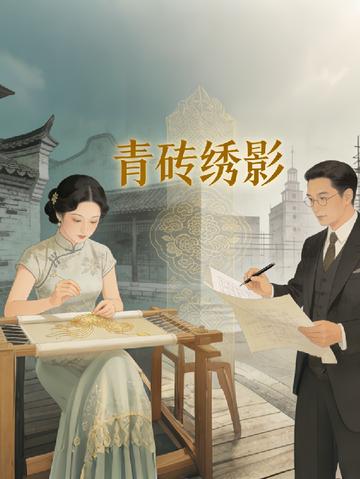
In the twelfth year of the Republic of China, the west wind spread from the east, and a battle between the old and the new was taking place among the blue bricks and black tiles of the old city.
Lu Shiheng, an architect who returned from studying abroad, embraced the ideal of "creating a new world" and was ordered to preside over the renovation of the old city, vowing to use steel and concrete to break the silence of the thousand-year-old alley. And Shen Zhiyi, an embroiderer who lives deep in the alley, guards her ancestral Kesi embroidery workshop. What she twists on her fingertips is not only gold thread and silver needles, but also the character and livelihood of generations.
Under the demolition order, the embroidery workshop is in danger. One wanted to overthrow the old world, and the other wanted to protect the roots and soul. The two went from a tit-for-tat stalemate to seeing each other's sincerity among the green bricks and gray tiles - he understood the warmth of craftsmanship in the warp and weft of the tapestry, and she understood the torrent of the times between the lines of the drawings.
But troubles came one after another: the yoke of forced marriage by the family tightened the throat, the iron hoof of forced demolition by the warlords approached step by step, and the impact of new ideological trends disturbed people's hearts. In the gap between tradition and modernity, Lu Shiheng and Shen Zhiyi stand hand in hand, not only to protect the embroidery workshop and keep the fire of intangible cultural heritage, but also to find a way to revive ancient art and rejuvenate the old city in the turbulent current situation.
The green bricks are rustling and the embroidery threads are densely seamed. This is a contest about persistence and breaking through, and it is also a sonorous harmony that belongs to the old and new eras.