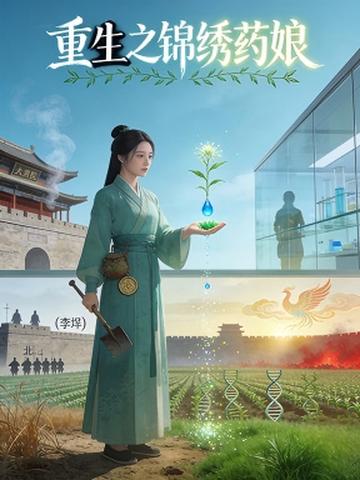
In her previous life, she was a top pharmacologist, but her director pushed her from a high-rise, and her blood stained the marble floor. In this life, she opens her eyes as an orphan girl in a mountain village, living in a drafty thatched hut while the clan chief and his men seize her last half-acre of medicinal farmland.
A tear falls on a patch of withered grass, and the blades instantly turn lush and green. She realizes in shock that she has been reborn with the "Shennong Physique." Her memories of her former life's laboratory become her strongest weapon: a bowl of "death-feigning medicine" makes the tyrannical clan chief "drop dead" in front of everyone; in a single night, the medicinal field miraculously produces rare herbs; and she braves the plague-stricken district, using her own blood as medicine to save an entire city...
In the Imperial Academy of Medicine, her enemy Chen Mingyuan exposes her identity as someone reborn. "Dr. Shen, business is like a battlefield. In this life, I still intend to defeat you." He spreads a plague and incites war, determined to prove that "women are unfit to practice medicine."
On the city wall, dressed in white as bright as snow, she scatters medicinal powder over a million enemy troops. "This medicine can cure the plague or become poison. The choice is yours." Where its fragrance fills the air, she faces her ultimate choice, guided by blood and tears.
From a thatched hut to the Imperial Academy of Medicine, from a persecuted orphan girl to the first woman ever appointed as a medical director, she overturns ancient prejudice with modern medicine and breaks millennia-old shackles with a compassionate heart. When Li Yan places the director's seal in her palm, she gently touches the medicine pouch at her waist. "In this life, I will live to a ripe old age under the name Shen Qinghe."
The fragrance of medicine crosses the ages, and the practice of medicine knows no gender. When green grass grows anew beside the memorial hall and a hundred young girls recite "The Healer's Benevolence," she finally understands: the greatest disease is not of the body, but of the human heart; the best medicine is not a magic herb, but equality.
One blade of grass, one waft of medicinal fragrance, one woman: she changes an entire era.