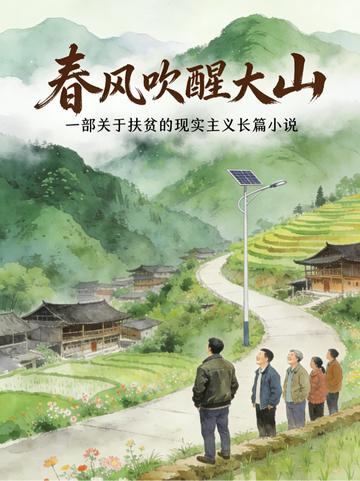
The mist-shrouded mountains of Miao Village were once a siege of poverty. The muddy mountain roads blocked the outside world. The villagers guarding the slopes were trapped in the obsession of "waiting and relying on things." The stitches of Miao embroidery were covered with dust, and the harvest of the terraced fields was not enough to fill their stomachs.
Lin Zhiyuan, the first secretary in the village, came to the village with a policy and sincerity, but he was first dashed by the suspicion of the villagers: Wang Laosi clung to his pride and refused to receive help, Li Chunhua hid his despair about life with vitriol, and Shi Mei, with her Miao embroidery skills, scorned the promises of "city cadres".
He did not rush to shout slogans, but squatted on the field ridge to look at the land, and sat by the fire pond to listen to his heart: building a cement road leading out of the mountain, and letting solar street lights illuminate the night of the Miao village; gathering scattered embroiderers into a cooperative, allowing Miao embroidery to spread across the country along the network; leading the villagers to plant tea seedlings and medicinal materials in the terraced fields, so that "golden knots" would grow on the barren mountains.
The wind blows from outside the mountains and rises from the heart of the people. When the first batch of industrial dividends are in the hands of the villagers, when the songs of the Miao village are accompanied by the laughter of tourists, the sleeping mountains are finally awakened by the spring breeze - this is not a lonely fight for poverty alleviation, but a group of people holding on to the warmth of the soil, planting the barren mountains into the appearance of spring.