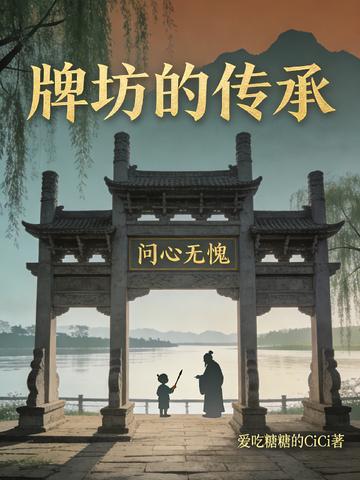
Introduction to the story of "The Legacy of the Archway"
During the Zhengde period of the Ming Dynasty, when Liu Ziqiang, a farmer from Fugou, was seven years old, with the encouragement of a pen gift from his fellow villager Xianping Zhiqi, he made an oath to "pile archways on top of archways". He studied hard while living in poverty, and became a Jinshi at the age of twenty-three. He worked from a minor official in the Ministry of Household Affairs to a minister in the three departments of Bing, Xing, and Hu.
During his thirty years in office, Liu Ziqiang petitioned for the people's lives in the Shandong Caoliang case and was demoted. He learned to compromise without losing the bottom line. In the thirty-eighth year of Jiajing's reign, he returned to his hometown and built three archways, with the design inscribed by Ping Zhiqi. The gold letters faded, and the two had a deep conversation by the river. Ping Zhiqi wrote "with a clear conscience" to wake up the lost. Liu Ziqiang was replaced by a stone plaque and demoted to Nanjing, and finally realized the true meaning of fame.
After returning to his hometown in his later years, Liu Ziqiang founded the Wenxin School and taught Ping Zhiqi the art of calligraphy and painting. The two passed away one after another, and their ashes were returned to the Jialu River. Over the past three hundred years, the archway was destroyed by war, and the stone plaque "with a clear conscience" was buried and reappeared. The child's oath, the officials' struggle, and the literati's perseverance turned into the four-character spirit, which was passed down from generation to generation in Fugou, like the endless river and the willow color every year.
This is a story about growth, loss and return, and it is also an eternal song that "caring for the people will last forever".
Like this book very much.