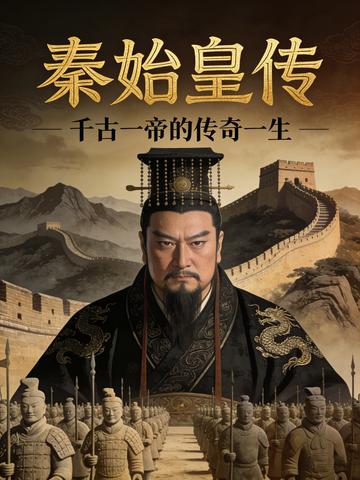
Ying Zheng (Qin Shihuang), China's first "emperor" and burdened with the reputation of a "tyrant" for two thousand years: conquered the Liuhe and built a unified empire in ten years, but died after his death. The institutional framework has been extended for two thousand years, and the controversy has not stopped.
This book uses a three-dimensional structure of "life + system + influence", relying on "Historical Records", "Qin Bamboo Slips" and archaeological discoveries, 100 chapters to restore his life and changes in the times: the rise of Qin Xicui, the years of prostitution in Handan, Qinian Palace's pro-government, sweeping the six countries; "Emperor" Names, Sangong and Jiuqing and the system of counties and counties, books and documents go in the same track; the controversy over the Lingqu Canal of the Great Wall, the burning of books and the entrapment of Confucian scholars, the changes in the sand dunes and the fall of the empire.
The author breaks away from the one-sided narrative of "tyrant" and affirms his achievements in ending war and unifying the system, without avoiding the shortcomings of tyranny and ideological suppression. The book explains in detail the strategy of unification and the logic of imperialism, focusing on the administration of Qin bamboo slips, the life of Qian Shou, the death of Fu Su, and the chaos of Zhao Gao. It compares the narratives of the Han Dynasty, "On Feudalism" and new archaeological evidence, and explores the impact of its institutional legacy on the shaping of Chinese political civilization.
This is not a biography of a single emperor, but a grand picture showing the changes in Zhou and Qin and the transformation of civilization. It will take readers through the fog and get in touch with the complex Qin Shihuang: a pioneer of brilliant strategies, a civilized reformer, a practitioner of centralization of power, and a dictator who overstretched the people's power. If you understand him, you will understand the core code of ancient Chinese politics and the dilemma of the origin of the unified empire.