"Accept the blessing and become our champion, or die now."
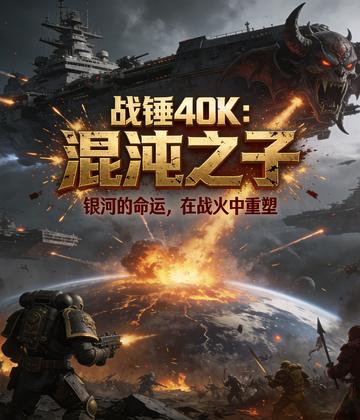
In the darkest corner of the Warhammer 40K universe, Li Jue faces this choice. An accident caused him to fall from modern society into the abyss of Terra, and he was marked by the four gods of Chaos at the same time. Tzeentch gave him the eyes to see the truth, Khorne gave him the power to tear everything apart, Slaanesh opened the limits of his senses, and Nurgle gave him unyielding life - but each "gift" has a price tag.
Within the Chaos forces, he is a highly suspicious "anomaly"; in the eyes of the empire, he is a "stain" that must be purified. The Blood Angels' pursuit never stops, and the power struggle within Chaos becomes alarming at every step. And above all this, the shadow of the Horus Heresy is casting its shadow over the heart of the Imperium of Man.
Li Jue discovered that his time travel was no accident. The Four Gods chose him in order to use him as an "anchor" to allow Chaos to fully come to reality when both the Emperor and the Warmaster were harmed. He is the key, the sacrifice, and the most special chess piece in the game of the gods.
But he decided to rewrite the rules.
Using his knowledge of Chaos's interior and his awareness of the empire's flaws, Li Jue walks a tightrope between the two sides. He saved Blood Angels soldiers and disrupted Chaos rituals; he delivered intelligence to the Inquisition and rescued innocents from the Underhive. In the final siege of Terra, when everyone thought he had to choose a side, he made a third choice:
Become the one who guards the gates of hell.
"I was once a plaything of Chaos, a prisoner of the Empire. Now, I am the Eye of Chaos - I owe no allegiance to any god or empire, only to those who try to remain human in the darkness."
Reader comments
Warhammer satirizes so many things: the blindness of religion, the killings brought by ambition, industrial pollution and disease, the desire of Slaanesh, and the double-edged sword brought by technology; people are a mixture of stitched emotions, and I just long for "beauty". Now they are all projections of negative emotions in the subspace. I want to see the struggle between the pros and cons of the four gods (such as letting Tzeentch enter Nurgle, "authority" split, [eating melon] Their children are called "life and new life")
Looking forward to the following plot, but I feel that the novel is not that simple and easy to understand.
Warhammer satirizes so many things: the blindness of religion, the killings brought by ambition, industrial pollution and disease, the desire of Slaanesh, and the double-edged sword brought by technology; people are a mixture of stitched emotions, and I just long for "beauty". Now they are all projections of negative emotions in the subspace. I want to see the struggle between the pros and cons of the four gods (such as letting Tzeentch enter Nurgle, "authority" split, [eating melon] Their children are called "life and new life")
Looking forward to the following plot, but I feel that the novel is not that simple and easy to understand.