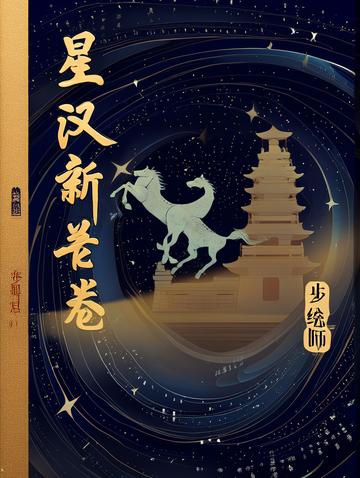
The New Star Chronicles tells the story of Lu Ming, a modern young man who accidentally transmigrates to blood-soaked Wancheng in the second year of Jian’an, becoming a tiny footnote struggling to survive in an age of chaos. Though he carries knowledge of history, he has no power to change the course of events. So he chooses a harder way to take part in his era: reforming logistics and psychological warfare after Guandu, planting the seeds of Jingnan reform amid the defeat at Red Cliffs, and founding a new-style academy in Luoyang that brings together the teachings of many schools. He navigates a world of historical giants such as Cao Cao, Xun Yu, Guo Jia, and Sima Yi, at once a participant and a clear-eyed observer. Amid the eternal struggle between ideals and reality, reform and tradition, fate and human agency, he seeks another way for civilization to endure.
This is not a power fantasy about crushing history with foreknowledge, but an experiment in civilization woven from reason and compassion. The protagonist has no golden finger, only a modern outlook and reverence for history. He improves institutions, yet remains constrained by human nature. He advances technology, yet must compromise with his times. Every attempt to move “ahead of its time” comes at a price. The book brings to life the late Han with meticulous historical research, features original poetry and prose, and closes each chapter with brief reflections on history and human nature.
Ultimately, the novel explores a central question: when someone knows how history ends, their greatest courage lies not in overturning it, but in carving out a stream alongside the current of history, however slight, that might lead to a broader future for human values and dignity. This is a love letter to history and a profound meditation on the question, “What makes us who we are?”

The writing is good and the plot is vivid
Amazing to read
Very good and worth recommending!