


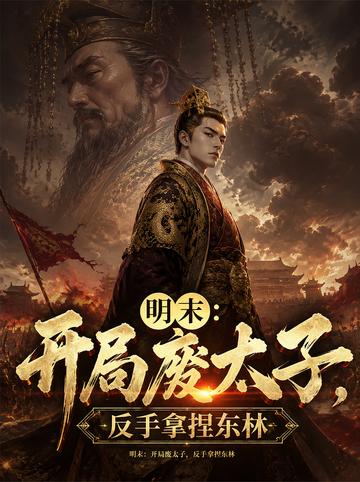
Late Ming: From the Start, I Depose the Crown Prince, Then Bring the Donglin Faction to Heel
明末:开局废太子,反手拿捏东林
- Status
- Ongoing
- Length
- 1.4M Words
- Genre
- Historical
- Subgenre
- Historical & Ancient
- Updated
- 18h ago
- Source
- Fanqie
Stats
Tags
Synopsis
In booklists 83
Explore more →
Looking for High-Quality Ming Dynasty Novels: Mighty Ming

Looking for a Highly Re-readable Novel That Doesn't Make Things Up As It Goes
Historical Fiction Set in an Imaginary Ancient World, No System
No System, no System, no System. Thanks, everyone.

Any Stories That Keep You Wanting to Read More and More? Recommendations, Please!
I’ve run out of books to read lately. Nothing good to read.
Deep, Thought-Provoking Stories That Feel Like Masterpieces
Something like *The Three-Body Problem*, for example.
The Ultimate Reading Drought Zone: Beginners Stay Out!
I’m a 60,000-Hour Veteran Bookworm, Already Entering the Great Vehicle Stage of Reading Slumps
Here Comes a 9.9-Rated Book
Picky Old Bookworms, Gather Here
The more books I read, the fewer I can stick with. What plot points or setups make you drop a book in one second?
Recommend Some Worthwhile Ming Dynasty Novels
I’ve read several books about the Ming Dynasty. Overall, they had excellent prose, deep historical knowledge, and well-crafted characters. But a few seem to share the same flaws: too much exposition and overly contrived schemes. Any good recommendations?
Stockpile Supplies, Keep a Low Profile, Seize Power, Build Your Own Base, and Fight Political Battles
Historical Fiction That Feels Realistic
No System, and nothing about The Legend of Qin. Just straight historical fiction.
The Best-Ever Ming Dynasty Novel
Looking for books like My Grandfather Is Zhu Yuanzhang.
My Favorite Historical Novel on Tomato Novel
I'm looking for books like Taking Another Name in Langya. Transmigration isn't a dinner party; it's a deadly game at every turn. The plot should be vivid and interesting, with side characters who are smart. The protagonist should slaughter their way through life-or-death situations. It should be historically accurate, with a natural romance.
Hand Over Every Novel You’ve Ever Stayed Up All Night Reading!!!
Looking for books similar to *Hong Kong Films: Ruling the World*.
High-IQ Historical Transmigration, Rich Historical Atmosphere, and Fixing Historical Regrets
Looking for books similar to *I, the Ming Dynasty Immortal, Lived Through Sixteen Emperors (The Immortal Guest of the Ming Dynasty)*.
I'm Extremely Picky. I've Read Over 400 Books and Only Added Two to My Library. Please Recommend Some
Looking for Historical Novels Set During the Industrial Revolution, the Victorian Era, or World War I and World War II
Soldiers, spies, secret agents, aristocrats.
Historical Novels About a Male Lead Born into an Aristocratic Clan Who Eventually Unifies the Realm
A decisive, cool-headed protagonist with a high IQ.
High-Quality Novels That Keep You Reading All Night
What’s the Most Popular Historical Novel on Tomato Novel?
I want something like Claiming the Surname Zhuge: Vast Heavens, Rebuild the Han Dynasty!
Any Hidden Gems That Get More Addictive the More You Read?
Transmigrate Into the Zhu Family, Save the Ming Dynasty, and Turn the Tide
High-Quality Historical Novels
Reader comments 70
Google Translate
This book is really good, especially the description of Lu Bu's fight for Diao Chan and Sun Wukong. Hundreds of people gathered together in the battle, but Xue Baochai was really too strong. If Nuoshou hadn't used an outer ring + Noxian guillotine, this wave of M4 six-fold strafing would have killed him. But I am more concerned about what Zhuge Liang said to the 108 monkeys in Huaguoshan, "Young man is proud, don't show off in front of your brother Liang", which shows Zhuge Liang's indignation at the monkeys who knocked him to death with three sticks. All in all, this book has an interesting plot, a clear system, and many foreshadowings. The fighting scenes feel like you are there, and the character descriptions are spot on! [Laughing evilly]
So far, it's a good read, but there's nothing too annoying about it that makes people watch it. Except that the author sometimes repeats some things, but it does not affect the perception. Alas, in a good book, the author likes to procrastinate and deliberately create a sense of tension. The problem is that the author's pacing is not well controlled and it is very historical. There are only so many words in one chapter, and the actual content is pitiful because of the procrastination. The content of updates of several chapters a day is not as good as others' two chapters.
I rarely write book reviews, but this time I have to. Although the author is slightly lacking in overall writing style and is not very sophisticated, overall there is no procrastination or system. He uses more power and human nature to describe the plot. This is better than too many historical questions. Overall, the score is definitely above eight points. It is a good book.
It is worthy of being written within the system, with a clear structure and a real strategy. It is not like other articles where you can already know what it means or have already guessed the next step. This big letter gives people a feeling that it can still be like this, and it also has this meaning. Take one step and count it as three steps, take one step and count it as ten steps, and take every step as a base. The four words "strategizing" are not adjectives. The author turned them into verbs. The protagonist's inner thoughts and real body movements (walking neither hastily nor slowly, as people in the system walk like this and speak slowly) and the calculation of controlling the situation.
Tomato Ming Dynasty is a rare fairy tale, and it would be a pity not to read it carefully. I read the latest chapter in one breath, eight words: hearty, interlocking, all the supporting characters are human beings, but the protagonist is more sophisticated. The only shortcoming that is not a shortcoming is that he is a little older after traveling to Zhu Changluo in his thirties [laughing and crying]
It is one of the best-looking Ming Dynasty novels I have ever read. Although the plot advances a bit slowly, the content is very reasonable. It is not a brainless novel, nor does it contain many cross-era things, nor is it a mentally retarded plot that treats the ancients as fools. It's getting better and better in the future, looking forward to it!
The faults do not hide the faults, there are shortcomings mentioned by people in the comment section, but the emotional drama is well written (not love!) There are many novels about historical hegemony. The protagonist has a system, has troubles, and survives from desperate situations. It is very exciting to watch the ups and downs of the protagonist's life. However, after reading it, I always feel that I can't remember the content. I just feel that I have read a refreshing article. But these recent ones have too much stamina. I think even if one day I forget the wonderful life that the protagonist in this book experienced, I will still remember the protagonist's care for those little people when he was young. That was not a show by an emperor to win people's hearts. He truly treated them as human beings. He is a truly modern-educated person who best practices the word equality!
It's only 7 o'clock? Fine chaff, this needs to be read carefully. Different from other golden fingers or technology lines, this is the first time I have read the Machiavellian line. I really feel that my eyes are bright. The writing is also good. I rarely comment but this book is worth commenting and recommending [Like][Like][Like] 🌿I feel like this would be great if made into a TV series or short series😯
The overall strategy and border defense layout are written very solidly, and the court game is full of tension. The plot progresses relatively slowly, and Wanli is forced to give in at Chapter 286. Just jump to what you want to see. The writing was weird and a bit stiff at first, but then I became more proficient and can read with confidence.
It breaks away from the stereotypes of the Hui Ming Dynasty and accurately describes the difficulty of seizing the heir. In particular, the data on the number of guards and purchasing power of the Ming Dynasty feel pragmatic, unlike the previous data on the Hui Ming Dynasty, which often included hundreds of thousands of silver coins and hundreds of thousands of troops. It is a good book, and I hope there are no eunuchs.