As the young artist Ling Feng paints The Transformation of the Sutra of Contemplation on the Buddha of Immeasurable Life, the luminous pearl in his brush suddenly bursts with strange light. A “double-helix hourglass seal” appears in the mural and pulls him into a centuries-spanning mission to protect civilization. The arrival of the Arab scholar Ibn al-Nadim reveals his destiny as an “Anni anchor”: “You must weave a century. Let knowledge seep in like a trickle, not burst forth like a flood.”
As the Abbasid Caliphate rises, the conflict between the Black-Clad Arabs and the Tang dynasty in Central Asia grows ever more intense. After the Battle of Talas in 751, Ling Feng becomes a traveler on the Silk Road and intervenes in history through “memory editing.” He implants a break in the transmission of papermaking techniques into the dreams of captured Tang craftsmen, delaying the westward spread of papermaking by thirty years. While lying low in Chang’an, he navigates the tensions between Japanese envoys and the eunuch factions, using his brush to record the hidden threads of cultural exchange. From Samarkand’s workshops making delicate paper to Sogdian merchant houses in Chang’an’s West Market, from the secret delivery of messages in Tibetan-occupied lands to the safeguarding of texts in the Mogao Caves, Ling Feng takes on the duty of a “weaver of dreams” in a mortal body. Amid the torrents of history, he plants the seeds of knowledge, letting the flame of civilization endure silently through the wars.
When the fires of the An Lushan Rebellion consume the glory of the High Tang, and Tibetan cavalry trample the Hexi Corridor, the “Silk Road of Knowledge” that Ling Feng and his successors have woven over a century will finally shine amid the drifting sands with a light of civilization beyond its age. This is an epic blending historical truth with fantastical imagination, a long hymn to the guardians of the Silk Road.
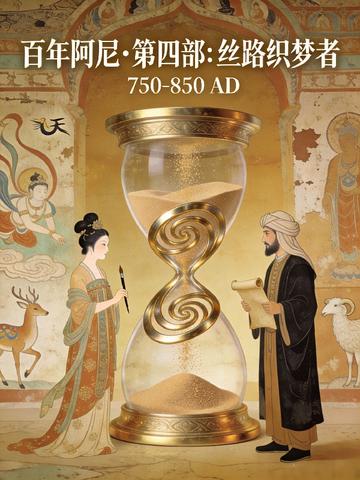











"A Hundred Years of Ani Part 4: Silk Road Dream Weaver" depicts the lonely epic of a transparent guardian during the hundred years of AD 750-850, when the Tang Dynasty turned from prosperity to decline. 22-Year-old painter Shen Lingfeng awakened in Dunhuang Mogao Grottoes and became the fourth anchor, shouldering the mission of "civilized safety officer". She cannot change the direction of history. She can only use invisible means such as memory weaving, rule pre-embedding, and speed control to make fine-tuning at key nodes such as the Talas Battlefield, the Maweiyi Mutiny, and the Yuanhe ZTE: delaying the spread of papermaking to the west to avoid technological abuse, encrypting "The Song of Feather Clothes" to protect military codes, and promoting the standardization of the Silk Road to establish a fair trade system. Over the past hundred years, she has increased the safety factor of civilization from 30% to 62% at the expense of the wear and tear of her own existence, winning three hundred years of safe growth for mankind. In the end, she encoded the Forty-nine Laws into the sand of Mingsha Mountain and sealed the century-old memory into a bronze mirror, making it completely transparent and integrated into the long river of history. Thousands of years later, her work was discovered by researchers from the interstellar era, and civilization finally understood: those seemingly natural stable periods of history were once guarded tenderly by an unknown woman with a hundred years of solitude.