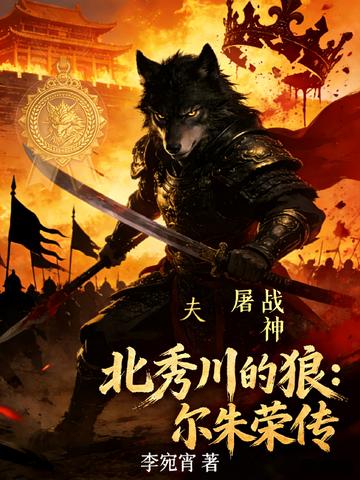
"The Wolf of Beixiuchuan"
In the last years of the Northern Wei Dynasty, wars raged across the six towns, and the empire was in danger. Chief Er Zhurong of Qihu led his cavalry southward, and was involved in the chess game in the Central Plains like a wild ride beyond the Great Wall.
He was the "God of War" on the battlefield, defeating 300,000 rebels with thousands of fine cavalry; he was also the "Butcher of Heyin" in the eyes of the Luoyang nobles, killing two thousand ministers overnight and staining the Yellow River with blood. He supported the puppet emperor and wielded power in both the government and the public. However, he was trapped by cultural barriers and power suspicion, and became increasingly lonely and violent on the throne.
The novel uses a cold writing style to dissect the contradictory core of this troubled hero: the desire for civilization is intertwined with inferiority, and the control of power and fear coexist. From the vast grasslands of Beixuchuan to the bloody pool of deep palaces in Luoyang City, Er Zhurong used his sword to cut a bloody path to the pinnacle of power, but he also dug a grave for himself.
When the young emperor, whom he despised, swung his butcher knife in the Xianyang Palace, an era collapsed. The death of Er Zhurong was not the end. The "wolves" under his command such as Gao Huan and Yu Wentai dispersed and divided the country, directly tearing apart the Northern Wei Dynasty and ushering in a darker era of warlord war.
This is not only a history of destruction by a hero, but also a mirror that reflects the nature of power: when violence becomes the only language, the savior will eventually become the greatest destroyer. In this epic tale full of iron-bloodedness and intrigue, you will witness how a man is swallowed up by his own ambition, and how an order completely collapses under the influence of absolute power.