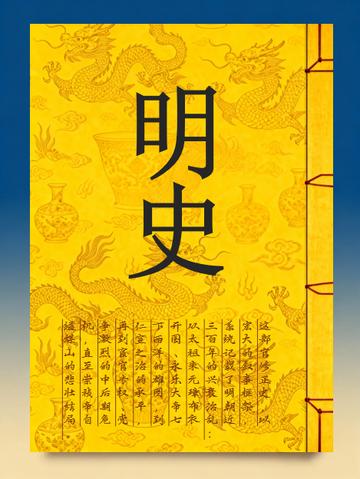
"History of the Ming Dynasty" is one of the most meticulously compiled and rigorous historical books among the "Twenty-Four Histories", and it took nearly a hundred years to complete. This official revised history uses a grand narrative framework to systematically record the rise, fall and chaos of the Ming Dynasty in the past three hundred years: from the founding of the country by the common people Zhu Yuanzhang, Emperor Yongle's ambition of seven voyages to the West, to the peace of Renxuan's rule, to the middle and later crises of eunuchs' monopoly power and fierce party disputes, to the tragic ending of Emperor Chongzhen's hanging on Meishan Mountain. Some of his chronicles such as "Food and Goods Chronicles", "Criminal Law Chronicles" and "Arts and Literature Chronicles" are full of information, and "Biography of Thieves" contains detailed records of the peasant wars in the late Ming Dynasty. Although some historical facts have been avoided due to political screening in the early Qing Dynasty, the overall content has become the most authoritative and systematic core historical book for studying the history of the Ming Dynasty due to its rich material, rigorous textual research, and narrative structure.