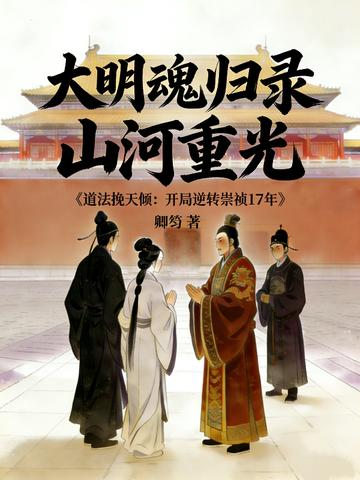
Also known as: "The Way of Taoism Saves the World: A Reversal of the 17th Year of Chongzhen"
On April 25, the seventeenth year of Chongzhen, the city of Beijing was about to be destroyed.
Under the old locust tree in Meishan, white silk hangs. Emperor Zhu Youjian of the Ming Dynasty had stepped onto the wooden bench, his eyes filled with deathly silence.
At the critical moment, a yellow talisman came through the air and cut off Bai Ling. Taoist priest Yun Qingzi of Longhu Mountain and his junior sister Lin Suyue used the "soul-locking talisman" to temporarily retain the dying soul of the emperor. However, the physical body is on the verge of death and there is no way to recover.
In order to turn the tide before it fell, Yun Qingzi took a desperate risk and activated the forbidden technique of "Soul Wandering in Taixu Formation" in Longhu Mountain, sending Chongzhen's soul into the gap in time and space to ask the ancestors of the Ming Dynasty for the way to govern the country.
In the territory of Taixu, Zhu Yuanzhang denounced the case, Zhu Di analyzed it coldly, and Zhu Zhanji taught earnestly... The souls of the former emperors gathered together and taught each other the gains and losses of governing the country for nearly three hundred years. Chongzhen cried bitterly in the void and repented, only to realize that being stubborn and suspicious, and eager for quick success and quick gain are the foundation of a country's destruction.
At the same time, in Beijing, Lin Suyue protected the emperor's body and dealt with the raids by the intruders; Yun Qingzi fought a life-and-death battle with the evil forces who had surrendered to the new dynasty to maintain the formation. After seven days of soul wandering, the world has been turned upside down.
The soul returns to the body and the king is "reborn". Chongzhen is no longer the headstrong king who subjugated his country, and Yun Qingzi is also faced with the biggest choice since his cultivation: Should he go with the will of heaven and let the dynasty change? Or go against the will of heaven and change your fate to save the people from the fire and water?
However, Taoism and law can change the victory or defeat in a moment, but it is difficult to change people's hearts through the ages. The true restoration of the country never lies in the rise and fall of one dynasty or one dynasty, but in the awakening of all people in the world.
"Is the Taoist going against heaven to save Daming?"
"It is not about saving one dynasty, but saving all the people in the world. The Tao is in the heart of heaven and in the hearts of the people."
Reader comments
This book is about recent thoughts and feelings. I often wonder if Chongzhen had not died (but I admired his solar terms in Meishan, so I decided to start writing from this point, so I tried every means to resurrect Chongzhen, and Taoism came into being to help the world.) The Ming Dynasty could be revived, would China be able to avoid the century-old humiliation in modern times? This is my first attempt at a complete creation. I know there are many shortcomings, but I still hope that others will improve.
The original intention of writing the book actually stems from the various feelings about the revolution between the Ming and Qing Dynasties, and also because of admiration for Chongzhen's integrity [the king dies in the country, and the emperor guards the country]. Finally, I hope that you readers will read the article rationally, and I am willing to discuss this hypothetical historical possibility with you in the comment area.
This book is about recent thoughts and feelings. I often wonder if Chongzhen had not died (but I admired his solar terms in Meishan, so I decided to start writing from this point, so I tried every means to resurrect Chongzhen, and Taoism came into being to help the world.) The Ming Dynasty could be revived, would China be able to avoid the century-old humiliation in modern times? This is my first attempt at a complete creation. I know there are many shortcomings, but I still hope that others will improve. The original intention of writing the book actually stems from the various feelings about the revolution between the Ming and Qing Dynasties, and also because of admiration for Chongzhen's integrity [the king dies in the country, and the emperor guards the country]. Finally, I hope that you readers will read the article rationally, and I am willing to discuss this hypothetical historical possibility with you in the comment area.