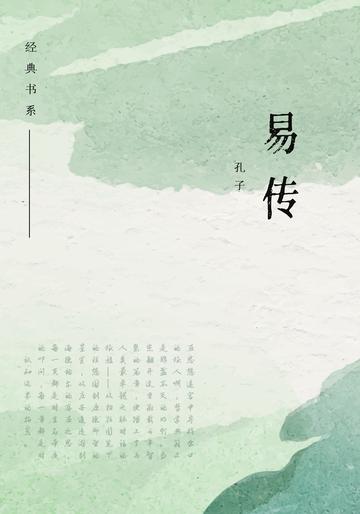
"Yi Zhuan" is an ancient classic work that provides systematic annotations and philosophical elucidation of the scriptures of "The Book of Changes" (also known as "The Book of Changes"). It is an important document for understanding the Yi studies, Confucianism and ancient cosmology.
The "Yi Zhuan" is usually collectively referred to as the "Ten Wings", including the upper and lower parts of the "Tuan Zhuan", the upper and lower parts of the "Xiang Zhuan", the upper and lower parts of the "Wenyan Zhuan", the upper and lower parts of the "Xici Zhuan", the "Shuo Gua Zhuan", "Xu Gua Zhuan" and "Miscellaneous Gua Zhuan". They not only explain the hexagrams and lines, but also discuss the creation of the universe, the changes of yin and yang, the relationship between heaven and man, and moral education, laying the foundation of ancient Chinese philosophy.
The book puts forward the view of the creation of the universe that "the great virtue of heaven and earth is life" and "life and life are called changes". It emphasizes the law of change that "when poverty leads to change, change leads to generalization, and generalization leads to long-lasting", it explains the laws of the operation of all things with "one yin and one yang is called Tao", forming a systematic philosophy of the universe and life.
"Yi Zhuan" integrates the divination function of "Yi Jing" with philosophical thoughts, revealing the interconnection between the way of heaven and the way of humanity. It is not only the key to interpreting the "Book of Changes", but also a great classic in the history of Chinese thought that connects nature, society and human relations. It has had a profound impact on later generations of philosophy, literature, ethics and cultural spirit.