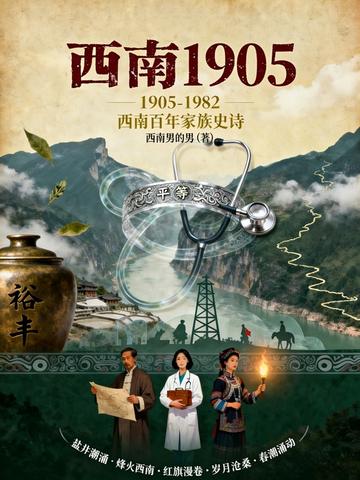
From the late Qing reforms of 1905 to the Reform and Opening-Up of 1982, Southwest 1905 uses Sichuan, Yunnan, and Guizhou as its backdrop. Through the ups and downs of three families, it paints a portrait of more than half a century of change in southwest China. The Sichuan salt merchants of the Zhao family, the Shen family of physicians who moved from Jiangsu to Yunnan, and the Mu Xia Yi chieftains of Liangshan each write their own answers to life's trials, balancing perseverance and innovation amid the dust of the Tea Horse Road and the tides of history.
The rise and fall of the Zhao family's salt business runs throughout the story. Zhao Wenxuan returns from studying in Japan with new techniques and a drive to modernize, while his second daughter, Zhao Wenjin, joins the revolution. Father, children, and siblings face difficult choices again and again during the Railway Protection Movement, the War of Resistance, and land reform. The Shen family pharmacy offers comfort through medicine, as Shen Manqing and Shen Ziyu uphold their duty as physicians amid war and upheaval. The Mu Xia family confronts the collapse of the chieftain system: A Zhi defends his clan, while A Yi seeks integration, both searching for a path to unity across ethnic divides.
Rooted in the soul of the southwest, the novel brings together the grandeur of the Three Gorges, the vast expanses of Yunnan and Guizhou, and local customs such as Gelaohui culture and the Torch Festival. Changes in the salt industry and Western medicine trade intertwine with tests of human nature. From the bustling salt wells of the late Qing to the surging spring tides of the new era, the three families endure separation and reunion, holding fast while embracing change. Their fates reflect social transformation and ethnic integration in the southwest, exploring the deep connections between tradition and modernity, the individual and the nation. Amid life's vicissitudes, reverence takes root; in the faintest glimmer, hope is kindled.