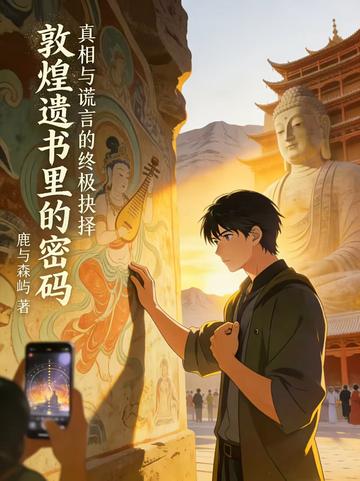
"The Code in the Dunhuang Posthumous Notes" is a wonderful story that combines history, suspense and thinking about human nature. The story revolves around Zhou Mingyuan, who is involved in a thousand-year battle between the pursuit of the truth and the protection of lies because of a fragment of the "Records of Su Zong" from the Tang Dynasty left by his grandfather. From the Suzhou Museum to the Scripture Cave of the Mogao Grottoes, Zhou Mingyuan gradually uncovered a secret guarded by his family for generations during the pursuit and decryption: a political lie that may subvert the historical view of the prosperous Tang Dynasty - his ancestors forged a secret letter of collusion between Anlu Mountain and the Khitan in order to protect the main force of the Tang Army's retreat, thus prompting Huihe to send troops.
As the hyperspectral scanner reveals the hidden scenes under the murals, the bronze fish talisman guides the direction of the star map, and the layers of hints from his grandfather's diary and Sogdian manuscripts, Zhou Mingyuan discovers that the "keepers of history" do not simply protect the truth, but maintain the officially recognized historical narrative. Li Jianguo and others, who claimed to be descendants of historians, tried to destroy these subversive evidences. In the end, Zhou Mingyuan chose to upload the secret to the International Dunhuang Project database, but deleted the local backup after completing the mission, so that the truth could be preserved in the world in an appropriate way.
Through exciting plot design and profound discussion of human nature, the novel shows the delicate balance between historical truth and conscience, and raises thought-provoking questions: Should we conceal part of the truth for the sake of greater justice? The Dunhuang sands bury secrets, but what cannot be blown away is mankind's eternal pursuit of truth and morality.