* **Reincarnation of the Way of Heaven:** Ninety-nine and eighty-one chapters, each volume is a test and sublimation of "Tao", from creation to governance, and finally to philosophy, forming a perfect closed loop.
* **One Lineage of Taoism:** The figure of Taoist Sanqing appears throughout. Fuxi's Bagua (Xuannu's Art of War, Dayu's control of floods) are the principles of "Tao"; Shennong's taste of grass and Dayu's control of floods are the actions of "Tao"; Laozi's "Tao Te Ching" is the words of "Tao". Reason, action, and speech are unified, and the doctrine is clear.
* **Echoes before and after:** Gonggong's "chaotic resentment" is the root of all disasters; Yinglong helped the human race twice, which represents the "authentic" recognition of "humanity"; from the severance of Jianmu to Laozi's release from seclusion, it explains the evolution of gods from "manifest" to "hidden" and then to "reason".
* **Rich characters:** From Suiren and Youchao to Cangjie and Leizu, every step of civilization has traces to follow. From Baize and Yinglong to Hebo and Wuzhiqi, the mythical world is full of rare and exotic animals and full of vitality.
* **The story is attractive:** Every episode is full of dramatic conflicts, including the war between armies and iron horses, but also the tragic songs about the love between children; the heroism of heroes, and the compassion of saints. The plot has ups and downs and is fascinating.
This "Daoyan Shenzhou Chronicle" will no longer be just a collection of myths, but an epic of the creation of Chinese civilization with "Tao" as the soul, "people" as the protagonist, and the "Eighty-One Difficulties" as the process. It explains the ultimate source of our cosmology, values and national spirit, and is enough to be passed down to future generations.
Reader comments
Through a closed-loop structure of ninety-nine and eighty-one chapters, the work shows the evolution of "Tao" from the law of creation to the ethics of the world: Fuxi's Bagua is the "principle of Tao", Dayu's water control is "the practice of Tao", and Laozi's five thousand words are "the words of Tao". Eventually, a Chinese spiritual pedigree was formed with "respect for heaven and ancestors, and constant self-improvement" as the core, achieving a deep integration of historical narrative and philosophical thinking.
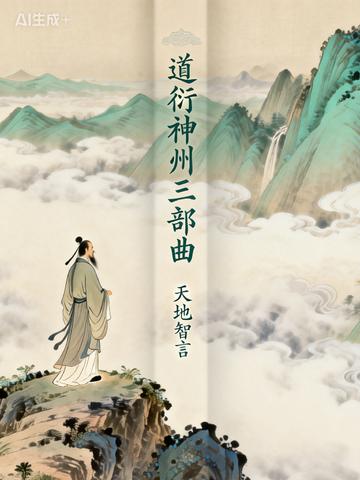
Through a closed-loop structure of ninety-nine and eighty-one chapters, the work shows the evolution of "Tao" from the law of creation to the ethics of the world: Fuxi's Bagua is the "principle of Tao", Dayu's water control is "the practice of Tao", and Laozi's five thousand words are "the words of Tao". Eventually, a Chinese spiritual pedigree was formed with "respect for heaven and ancestors, and constant self-improvement" as the core, achieving a deep integration of historical narrative and philosophical thinking.