A masterpiece by Professor Han Sheng of Fudan University, and a classic course from the Lecture Room series! Discover why a glorious age collapsed, and how Chang'an became a place its descendants could never return to!
"In the tenth month, I shall certainly go to the capital."
In the seventh month of the fourteenth year of Tianbao (755), Emperor Xuanzong of Tang invited An Lushan to bathe with him in the newly prepared hot spring at Huaqing Pool. An Lushan gave this confident reply. Xuanzong believed him without a doubt, lost in the illusion of harmony between ruler and subject, completely unaware of the murderous intent hidden behind the words "certainly go"...
Then came "the drums of Yuyang shook the earth." In the eleventh month, An Lushan led an army of two hundred thousand south, swept across Hebei, crossed the Yellow River, and captured both capitals, Luoyang and Chang'an. Xuanzong fled in panic to Shu. The An Lushan Rebellion lasted eight years, its flames consuming northern China. In the blink of an eye, a world of lavish splendor became a distant memory.
Yet the mighty Tang dynasty was not brought to its knees by a single military rebellion. The real collapse came from upheaval deep in people's hearts: foreigners became the source of all evil, and xenophobia became the social norm. From then on, the Tang's diverse and open character came to an abrupt end, leaving its descendants only the wistful image of a bygone golden age...
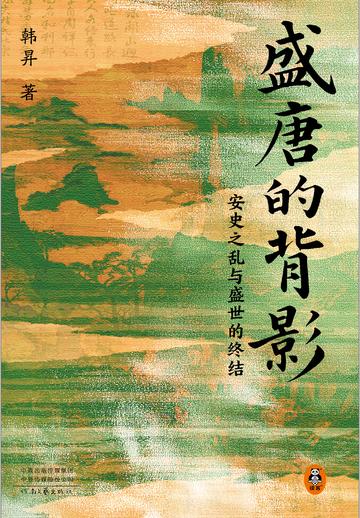

OK, I have finished reading "The Back of the Prosperous Tang Dynasty", it really feels like a lecture!!! Recently, I have been looking back at the previous series of Baijia Lectures. It is really very good. Professor Han Sheng's book is based on the classic courses he taught at Baijia Lectures. It seems that his narration also appeared in my mind. My understanding of the Anshi Rebellion is only superficial. This book The book truly took me to understand the panoramic view of the Anshi Rebellion, and also gave me in-depth reflections on the predicament of social transformation. It uses the Anshi Rebellion to enlighten us on how to reflect on the solutions. It is really "future generations will grieve and ignore it, and it will also make future generations mourn for future generations." [Working in progress] [Working in progress] [Working in progress]
Teacher Han Sheng's "The Back of the Prosperous Tang Dynasty" narrates the causes, processes, results and profound impact on later generations of the Anshi Rebellion from multiple angles. In the textbook, we only tell us that in 755 AD, the Anshi Rebellion occurred, and that the Tang Dynasty fell in 906. In just three lines, everything happened after the prosperous Kaiyuan Dynasty. Why did the Anshi Rebellion happen in the prosperous Tang Dynasty, which seemed to be the heyday of the feudal dynasty? I have never delved into the reasons behind it. After reading it today, I just frowned and sighed deeply. But in the process of reading this book, there were many times when I gritted my teeth and my eyes were about to burst. A few lines of short comments could not express my overwhelming anger towards the political struggle. How many times I burst into tears, unable to help myself and unable to express my respect for many heroes in words. At the end of the book, teacher Han Sheng analyzed the internal causes of the Anshi Rebellion from the perspectives of institutions and politics, and told me that I should not be angry at one or two people or one or two things alone. It was because the rulers' vision could not adapt to the development of the social situation, which led to the concentrated outbreak of conflicts. After reading it, I felt sad again, how much was the Anshi Rebellion? The massacre of the city resulted in countless deaths and injuries, and the blood of many people stained the ground under their feet red. I repeatedly smacked the words in my mouth, "In prosperity, the people suffer; in death, the people suffer." It turns out that behind Zhang Yanghao's emotion is a horrifying accumulation of history. Before and after the entire Anshi Rebellion, who had considered the people and thought of the country. The Anshi Rebellion is over. The eight-year war, the devastated mountains and rivers and homes, the displaced people, and the tragedy of everyone eating each other are not over yet. The once prosperous Tang Dynasty has no longer regained its former glory, and has fallen into a new quagmire, waiting for death. I am lucky to be able to re-understand the Anshi Rebellion through the writings of Teacher Han Sheng. Thank you, Teacher Han Sheng, for bringing your unique insights to us. Highly recommended, a worthwhile read.
Most books on history present historical facts in the form of a running account. However, this book is not the case. The content is very exciting, the plot is fascinating, and at the same time it does not lose its objectivity. Quite recommended!
Good analysis and strict logic
Not boring, very interesting, not ridiculous, rare!