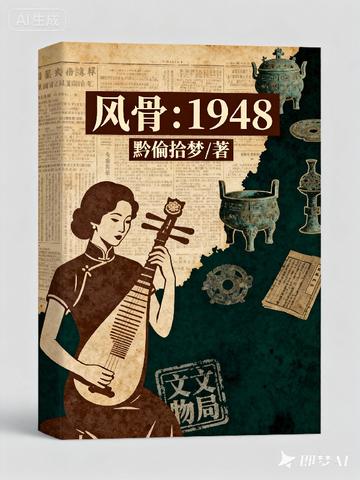
In the winter of 1948, the Jinling Pipa family collapsed overnight. Lin Wanzhou, the eldest daughter of the Lin family, witnessed the ancestral pipa being smashed when her fiancé Shen Moshu led troops to ransack the home, and the photos of studying in Japan hidden in her belly were exposed. To save her life, her mother knelt down in public and gave her a silver key and a secret message: "Go to Shanghai to find Master Qin Jiu and tell him that the plum blossoms in Jinling are blooming."
On the way to escape, the shipwreck was in danger. Lin Wanzhou met the mysterious businessman Gu Canghai and learned the true identity of his father Lin Huaijin - the "night watchman" of the "Southern Cultural Relocation" plan. A collection of Yuefu Poems contains thirteen lost pipa music scores, "Thirteen Tunes of Feng Gu". Each music score corresponds to a national treasure burial place, and also records the bloodline genealogy of past guardians.
There is an undercurrent on the beach in Shanghai. The fourth master of the Green Gang, the new leader of the Ju Organization, the remnants of the military command, the mysterious "Triple Gate" organization... All forces covet the treasure. Lin Wanzhou discovered that there was a mole among the Thirteen Guardians, and his cousin Zhou Mingtang, who had been pretending to be dead for ten years, suddenly appeared, bringing the shocking truth that his father was "buried alive."
From Jinling to Shanghai, from Lanzhu Mountain in Shaoxing to the air-raid shelter in Chongqing, Lin Wanzhou uncovered layers of fog in troubled times: cultural relics are dead, but people are alive. The true "bone of character" is not a national treasure buried deep in the ground, but the will to protect it from generation to generation. It is the backbone of civilization that is not broken in times of crisis.
"A broken string can be restored, but a person's soul remains after death. As long as there is still one person who remembers it, the cultural context will never die."