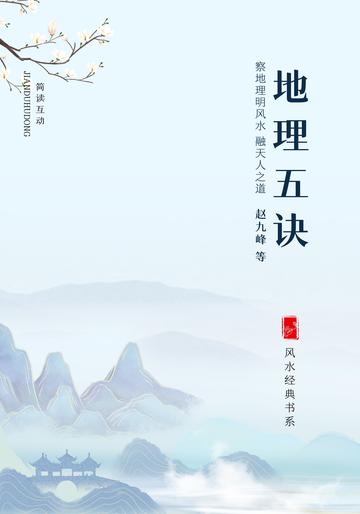
"Five Secrets of Geography" was written by Zhao Jiufeng and was written during the Qianlong period of the Qing Dynasty. It is one of the important representative works of traditional Kanyu Feng Shui.
The book consists of eight volumes, systematically expounding the situation, qi, and site selection principles in mountainous and ocean environments. The core is based on the "Five Secrets" - dragon, cave, sand, water, and direction - to determine the good and bad luck of geography.
Volume 1 discusses the basics of the five elements and the use of the compass, laying the theoretical foundation for Kanyu; Volumes 2 to 5 respectively describe the trend of dragon veins, the authenticity of acupuncture points, the surrounding sand, the coming and going of water mouths, and the principle of "entering the spirit and retreating the spirit"; Volumes 6 and 7 discuss the coordination of mountain directions and water mouths, and the correspondence between the twenty-four mountain directions and the twelve water methods; Volume 8 specializes in the method of flat ocean terrain, which is suitable for the layout of tombs in Jiangnan, water towns and other areas.
Zhao Jiufeng learned extensively from his predecessors and integrated the Situation School and Liqi School theories to form a systematic and complete geographical survey system. The text of his book is concise and the principles are clear. It can be used for practical observation of Feng Shui and has theoretical guidance significance.
"Five Secrets of Geography" had a profound influence in the Qing Dynasty and later generations. It is an important classic for studying Feng Shui and studying traditional Chinese geography and environmental philosophy.