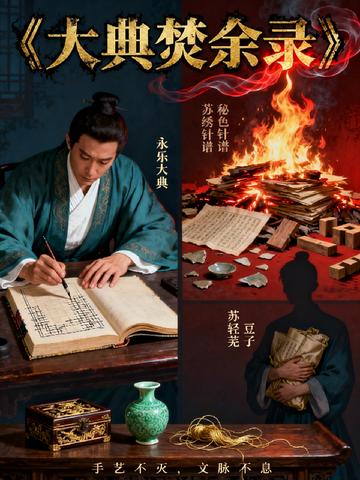
Taking the compilation of "Yongle Dadian" during the Yongle period as the background, it focuses on the tragedy of the survival of folk skills. Hanlin editor Qin Yanqiu moved into Beijing with the fragments of "Secrets of Hundred Works" left behind by his grandfather. He wanted to include woodworking mortise and tenon joints, Suzhou embroidery stitches, secret color glaze firing and other folk skills into the ceremony, but he ran into the cultural Qing Dynasty led by Wang Jin, the eunuch and eunuch. Washing - all "unorthodox" techniques were denounced as "strange and obscene skills", the "Su Embroidery Needle Manual" was torn up, Jingdezhen kiln worker Zhou kiln master died tragically in prison for refusing to submit "Kiln Fire Secret Record", and Suzhou embroiderer Su Qingwu fled to the world to protect the needle manual.
When the red pen in the official classics changed the marking of "swallowtail tenon" to "official mortise and tenon", and when the secret glaze formula was burned, Qin Yanqiu, with the secret help of the young eunuch Xiaodouzi, used a small pen to copy the technical diagram into the margin of the blank page of the official book, disguised as "notes on classics and history"; he even conspired with Su Qingwu to embroider double-sided embroidery stitches into the lining of official uniforms. When the 20,000-volume splendid canon was declared to be "all-encompassing", only the broken pages in the interlayer and the stitches on the garments contained the blood and tears oath of the folk craftsmen that "the craftsmanship will never be destroyed". This secret history, which combines the wisdom of carpentry, the determination of embroiderers and the warmth of kiln fire, tears away the gorgeous cloak of "cultural unity" and reveals the glimmer of civilization that will never go out like embers under the iron heel of autocracy.